OFFICIAL USCIS 2025 TEXTBOOK

One Nation, One People: The Complete Study Guide

Every chapter of the official USCIS 2025 civics test textbook, plus all 128 official test questions and answers searchable, illustrated, and organized by topic.

Chapters

Jump to any chapter

CHAPTER 1

The U.s. Constitution

The U.s. Constitution

What you'll learn in this chapter

  • The U.S. Constitution.
  • When the Constitution was written.
  • What the Constitution says.
  • Why the Constitution is the most important document in the United States government.

The U.S. Constitution was written in 1787. It is the oldest written constitution in the world. The Constitution sets up the government and enshrines the basic rights of the American People.

The Constitution was written during the period when the country was created. Another word for created is “founded.” The period when the country was created is called the Founding Era. In 1787, famous leaders from around the country like George Washington, Benjamin Franklin, James Madison, and Alexander Hamilton came to Philadelphia, Pennsylvania, for a Constitutional Convention. The leaders who met at the Constitutional Convention are sometimes called the Founders. The Founders wrote the Constitution at the Constitutional Convention.

When the Founders wrote the Constitution in 1787, it had a Preamble and seven sections. There have been changes made to the Constitution since it was written. A change to the Constitution is called an amendment. There are 27 amendments to the Constitution. The 27 amendments are listed after the seven sections of the original Constitution.

“Scene at the Signing of the Constitution,” by Howard Chandler Christy. Courtesy of the Library of Congress.

WE THE PEOPLE

The beginning of the Constitution is called the Preamble. The Preamble to the Constitution explains why the Founders wrote the Constitution.

The Constitution of the United States. Courtesy of the National Archives.

The Preamble also says that under the Constitution, the people of the United States will have self-government. This means that the people of the United States are not governed by a king or a queen. Instead, the people of the United States govern themselves. The people of the United States govern themselves by electing representatives who serve in the local, state, and U.S. governments.

The idea of self-government is in the first three words of the Constitution. These words are, “We the people”.

THE FEDERAL GOVERNMENT

The Three Branches of Government

The first three sections of the Constitution set up the U.S. government. These sections of the Constitution describe the three branches or parts of the U.S. government. The U.S. government is also called the federal government.

The three branches of government are called the Legislative Branch, the Executive Branch, and the Judicial Branch.
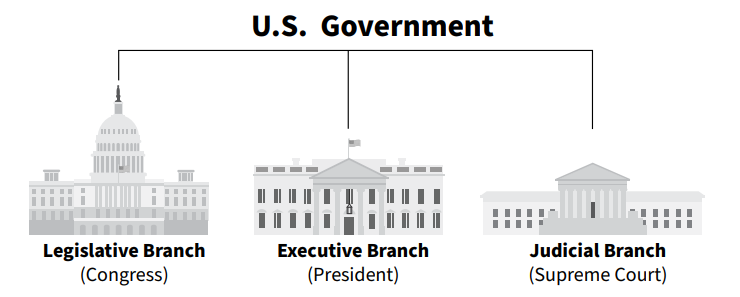
Diagram

The Legislative Branch is also called Congress. There are two parts to the U.S. Congress. They are called the House of Representatives and the Senate.
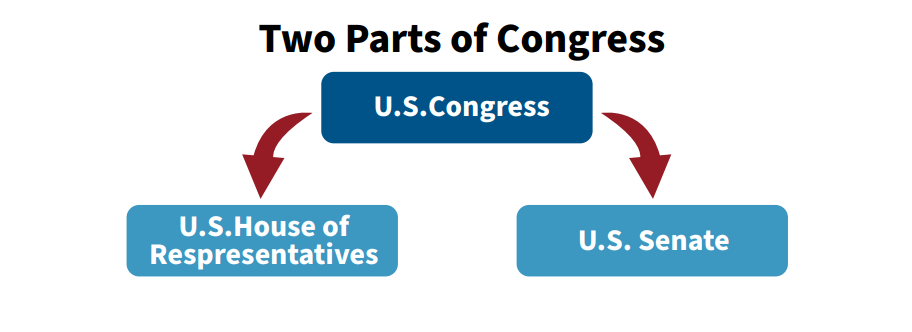
Diagram showing the two parts of the U.S. Congress: the U.S. House of Representatives and the U.S. Senate.

The President of the United States is in charge of the Executive Branch. Other parts of the Executive Branch include:

  • The Vice President of the United States
  • The President’s Cabinet
  • In government, a “cabinet” is another word for a “group of advisors.” The President’s Cabinet advises the President.
  • The Executive Departments and agencies in the U.S. government

The parts of the Judicial Branch are the Supreme Court and other federal courts. The Supreme Court is the highest court in the U.S.

The U.S. Capitol in Washington, D.C.

Separation of Powers

During the Constitutional Convention, the Founders were afraid that if one person or group has too much power, then they could take over the country. They decided to separate the powers of government so that no one person or group could become too powerful. The Constitution gives each branch of government different powers. This is called “separation of powers.” Separation of powers stops one branch from becoming too powerful.

The powers of each branch of government are:
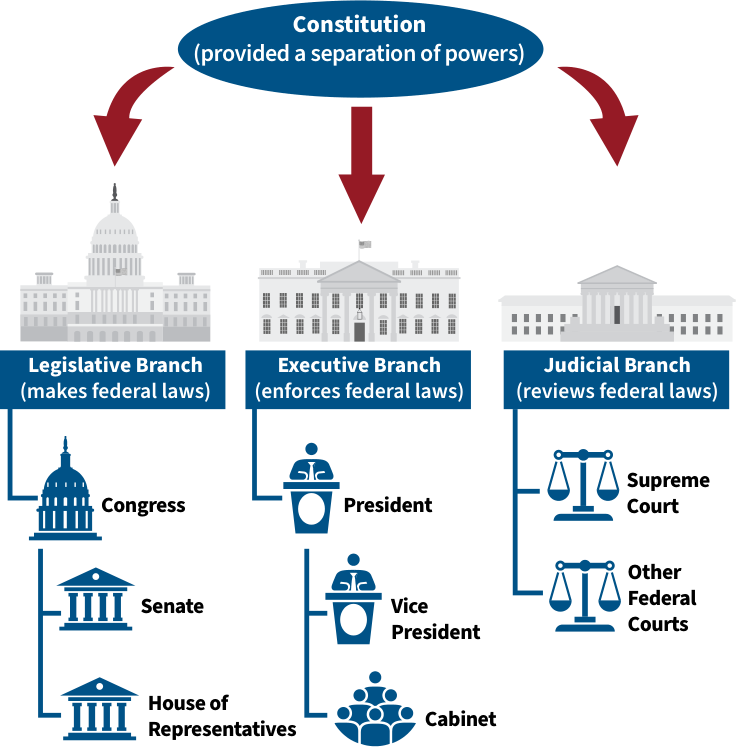
  • The Legislative Branch (Congress) makes federal laws.
  • The Executive Branch enforces federal laws.
  • The Judicial Branch reviews federal laws.
Diagram showing how the Constitution provided a separation of powers across the Legislative, Executive, and Judicial branches.

Powers of the Federal Government

The Constitution also lists the powers that the federal government has, such as the power to protect the people of the United States.

For example, under the Constitution, the federal government has the power to create an army to defend the nation, and to declare war if the U.S. has been attacked or is under threat.

Members of the U.S. military.

The federal government also has the power to make treaties. A treaty is an agreement between two or more countries. Sometimes the federal government signs treaties with other countries to end wars or conflicts. Other times, the federal government signs treaties with countries to work together on issues like trade.

Another power that the federal government has under the Constitution is to print money. Only the U.S. government has the power to print the dollar bills and coins that people use for money in the United States.

U.S. coins and currency.
Signing of mutual cooperation treaty with Japan in the East Room of the White House, January 1960. Courtesy of the Library of Congress.

STATE GOVERNMENTS

The fourth section of the Constitution explains how state governments are set up. This section also explains how new states can join the United States.

Washington, D.C., does not have a governor because it is not a U.S. state. Washington, D.C., residents should answer that D.C. does not have a governor.

The Constitution says that each state will have a government that has a legislative branch, an executive branch, and a judicial branch.

The person in charge of the executive branch for a state government is a called a governor. Each of the 50 states has a governor. To find out who is the governor of your state now, please visit: usa.gov/state-governor.

Under the Constitution, powers not delegated to the United States by the Constitution, nor prohibited by it to the states, are reserved for the states respectively, or to the people.

For example, state governments have the power to provide the people of their state with protection and safety. One way that state governments do this is by providing the people in their state with police departments and fire departments.

State governments also have the power to provide the people of their state with schooling and education. Each state in the U.S. has its own educational system for students in grade school, colleges and universities, and adult education programs.

Students in a U.S. classroom.
Fighting fires is among a state’s powers.

CHANGING THE CONSTITUTION

The fifth section of the Constitution explains how the Constitution can be changed. A change to the Constitution is called an amendment. The Founders wanted the people of the United States to be able to make changes to the Constitution. They believed that in order to have self-government, the people of the United States should be able to make changes to the Constitution and the government.

For an amendment to be added to the Constitution it must be approved by three-fourths of the states in the United States. Today there are 50 states in the U.S. That means that 38 out of the 50 states must approve an amendment for it to be added to the Constitution. There are 27 amendments to the Constitution.

SUPREME LAW OF THE LAND

The sixth section of the Constitution says the Constitution is the supreme law of the land in the United States. This means that everyone living in the United States must follow the Constitution. In the United States, we support the “rule of law.” This means that we believe that no one is above the law, and everyone must follow the law. This also means that the U.S. government, state governments, and local governments must follow the Constitution and the rule of law.

Statue of Lady Justice
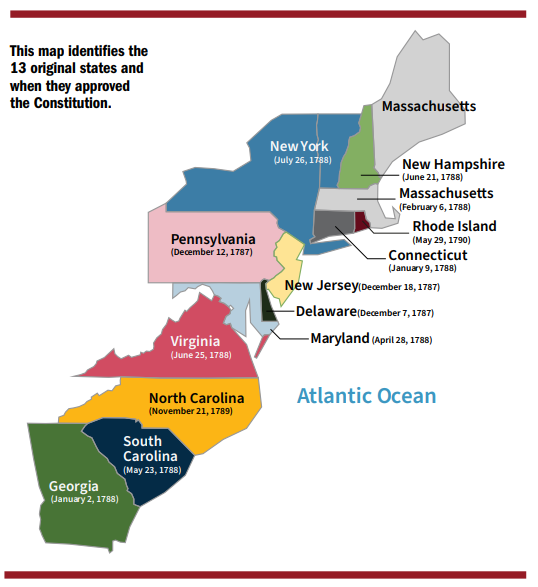
Map identifying the 13 original states and when they approved the Constitution.

APPROVING THE CONSTITUTION

The seventh section of the Constitution says that the people of the United States had to approve the Constitution for it to become the law of the land. When the Founders wrote the Constitution, there were 13 states in the U.S. The Constitution says that nine of the 13 original states must approve the Constitution. In 1788, New Hampshire became the ninth state to approve the Constitution, and all 13 original states approved the Constitution by 1790.

The Bill of Rights to the U.S. Constitution.

AMENDMENTS TO THE CONSTITUTION

When the Constitution was written in 1787, it did not list any of the rights of individuals. Many of the Founders believed that the Constitution should include a list of the rights of people living in the United States.

The Founders decided to add 10 amendments to the Constitution. The first 10 amendments to the Constitution are called the Bill of Rights. The Bill of Rights lists some of the basic rights of people living in the United States.

There are 27 amendments to the Constitution. Some of the amendments that were added to the Constitution after the Bill of Rights describe who can be a U.S. citizen, and who can vote in elections in the United States.

↑ Back to chapters
CHAPTER 2

The Legislative Branch (Congress)

The Legislative Branch (Congress)

What you'll learn in this chapter

  • The Legislative Branch of the U.S. government.
  • The Senate.
  • The House of Representatives.
  • The process for making federal laws.

The Legislative Branch is one branch or part of the government. Another name for the Legislative Branch is the U.S. Congress.

The Constitution says that Congress makes federal laws. When the Founders were writing the Constitution, they believed that the power to make laws is the most important power in government. This is why the first section of the Constitution describes Congress and the power to make federal laws.

During the Constitutional Convention, the Founders agreed that the people who make laws should represent the states or parts of states where they lived.

When the Constitutional Convention started, the Founders did not agree on how many representatives each state should have in Congress. Some people thought that the number of representatives from each state should be based on the number of people living in the state. Others thought that each state should have the same number of representa­ tives, no matter how many people lived in the state. They came to an agreement to have two parts to the U.S. Congress. The two parts to the U.S. Congress are the House of Representatives and the Senate.

States that have more people have more representatives in the House of Representatives, and every state in the United States has two U.S. Senators.
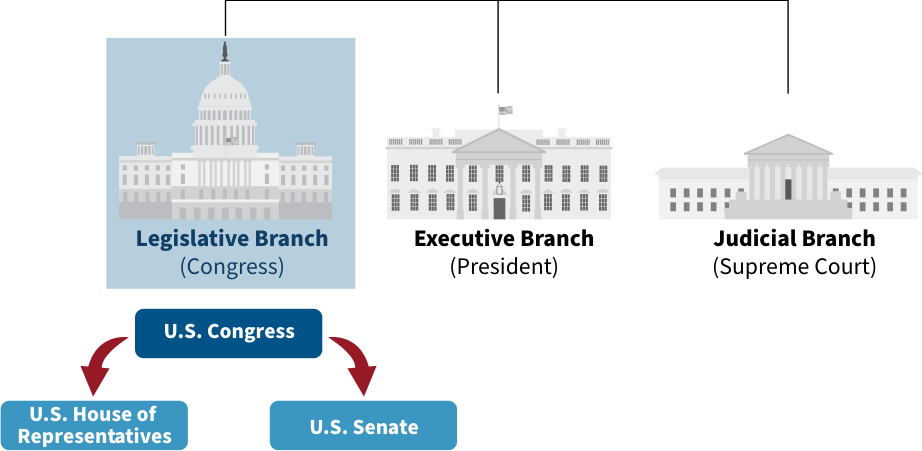
Diagram

THE HOUSE OF REPRESENTATIVES

Voting Members of the House of Representatives

There are 435 voting members in the House of Representatives.

Each state is divided into congressional districts. The 435 voting members of the House of Representatives come from congressional districts from each of the 50 states. Each congressional district elects a person to serve as a representative in the House of Representatives.

Some states have more representatives in the House of Representatives than others. This is because states that have more people have more representatives in the House of Representatives.
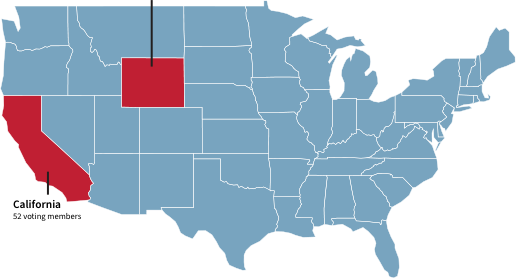
Map showing California (52 voting members) and Wyoming (1 voting member) in the House of Representatives.

Example:

California:

  • is the state with the most people.
  • has 52 voting members in the House of Representatives.

Wyoming:

  • is the state with the least people.
  • has one voting member in the House of Representatives.

Electing Members of the House of Representatives

Members of the House of Representatives are elected every two years.

The United States Capitol in Washington, D.C., is the meeting place of the nation’s legislature, the U.S. Congress.

To get elected to the House of Representatives, a person must be at least 25 years of age and live in the state where the congressional district is located.

One right that is only for U.S. citizens is to run for federal office. This means that a person must be a U.S. citizen to get elected to the House of Representatives.

To find the name of your Representative for your congressional district please visit: house.gov.

The leader of the House of Representatives is called the Speaker of the House.

To find the name of the current Speaker of the House, please visit: speaker.gov.

THE SENATE

U.S. Senators

There are 100 U.S. Senators in the Senate. Senators represent all the people of a state.

Electing U.S. Senators

U.S. Senators are elected for six years. To get elected to the Senate, a person must be at least 30 years of age and they must live in the state that they represent.

Each state has two U.S. Senators.

Example:

One right that is only for U.S. citizens is to run for federal office. This means that a person must be a U.S. citizen to get elected to the Senate.
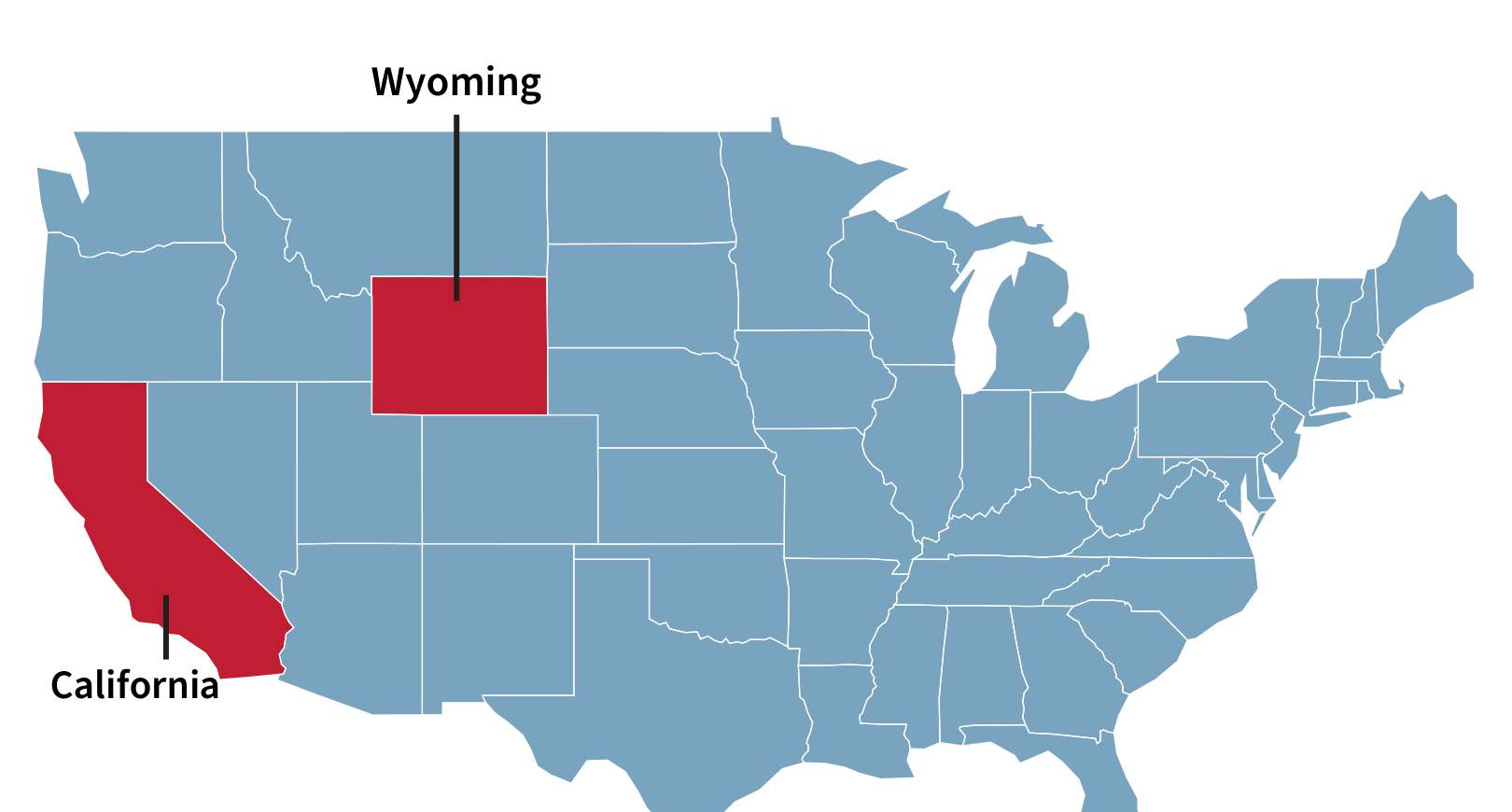
Map showing California and Wyoming, which both have two U.S. Senators.
  • The states of California and Wyoming both have two U.S. Senators.

To find the name of your U.S. Senators, please visit: senate.gov.

Washington, D.C., does not have any senators because it is not a U.S. state. Washington, D.C., residents should answer that D.C. does not have a senator.
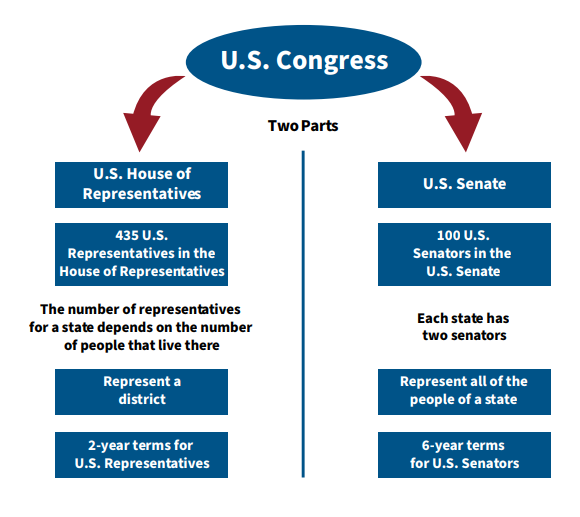
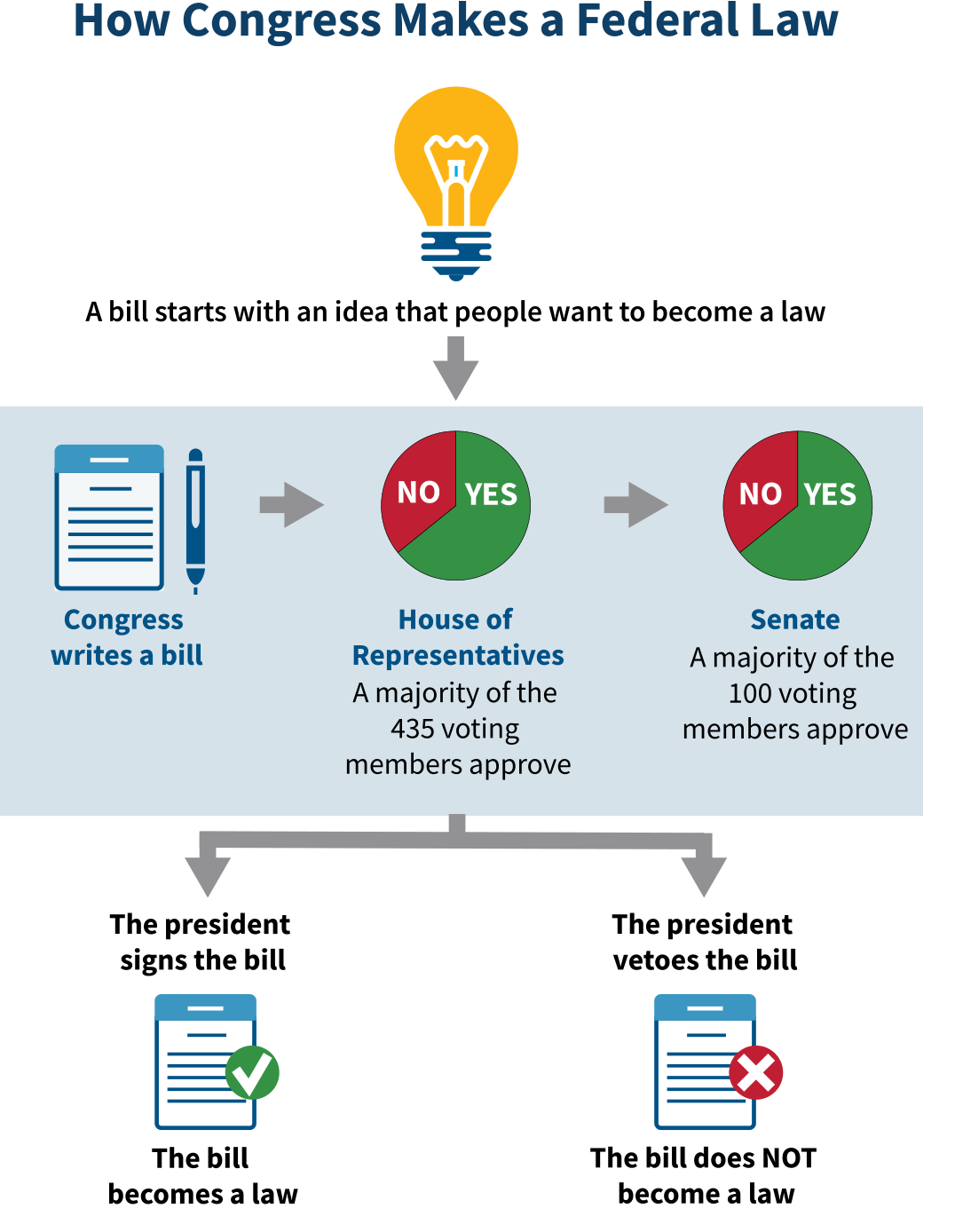
Diagram comparing the two parts of the U.S. Congress: the U.S. House of Representatives and the U.S. Senate.

MAKING FEDERAL LAWS

How Congress makes a federal law: a bill starts as an idea, passes the House and Senate, then the President signs or vetoes it.
The Oval Office of the White House. Photo by Cecil Stoughton. Courtesy of the John F. Kennedy Presidential Library and Museum.

The Constitution says that Congress makes federal laws. A “law” is another word for a “rule” that people must follow. A “federal law” is another word for a “rule” that everyone in the United States must follow.

When members of Congress want to make a new law, they write a “bill.” A bill is a proposal for a new law. For Congress to pass a bill, a majority of both the House of Representatives and the Senate must vote for it. This means that more than half of the voting members in the House of Representatives and U.S. Senators must vote in support of the bill.

For example, there are 435 voting members in the House of Representatives. For a bill to pass the House of Representatives, 218 members (or the majority of those voting and present) must vote in favor of the bill.

There are 100 U.S. Senators in the Senate. For most bills to pass the Senate, 51 U.S. Senators (or the majority of those voting and present) must vote in favor of it.

If both parts of Congress pass the bill, then the bill is sent to the President of the United States.

If the President agrees with the bill, then the President signs the bill into law. This means that everyone in the country must follow the law that the President signed.

If the President does not agree with the bill, then the President vetoes the bill. The word “veto” means that the President did not sign the bill. Then the bill does not become a law unless Congress votes to override the veto.

↑ Back to chapters
CHAPTER 3

The Executive Branch

The Executive Branch

What you'll learn in this chapter

  • The Executive Branch.
  • The President of the United States.
  • The agencies in the federal government.

The Executive Branch is one branch or part of the U.S. government. The President of the United States is in charge of the Executive Branch.

The other parts of the Executive Branch are the President’s Cabinet, the Vice President of the United States, and the Executive Departments and agencies in the federal government.

During the Constitutional Convention, the Founders were afraid that if the President had too much power, then the President would be above the law and could become a king or queen. The Founders believed that in the United States no one is above the law. This is called the “rule of law”. The Founders believed that the President should have the power to protect and serve the people of the United States. They also believed that the President should follow the rule of law.

THE PRESIDENT’S CABINET

The Executive Branch includes the Executive Departments and agencies that are part of the federal government. The Executive Departments and agencies help the President to enforce laws, protect the country, work with other countries, and provide services to the people of the United States. The people who lead the Executive Departments are mostly called Secretaries. For example, the person who leads the Department of Homeland Security is called the Secretary of Homeland Security.

Diagram showing the three branches of the U.S. government: Legislative (Congress), Executive (President), and Judicial (Supreme Court).
The three branches of the U.S. government.

The leaders of the Executive Departments are also called Cabinet-level positions because the people who lead each agency are part of the President’s Cabinet. A “cabinet” is another word for a “group of advisors.” The President’s Cabinet advises the President. The President can also choose to have other people from the federal government serve on the Cabinet.

The Cabinet-level positions include:

  • Attorney General
  • Secretary of Agriculture
  • Secretary of Commerce
  • Secretary of Education
  • Secretary of Energy
  • Secretary of Health and Human Services
  • Secretary of Homeland Security
  • Secretary of Housing and Urban Development
  • Secretary of the Interior
  • Secretary of Labor
  • Secretary of State
  • Secretary of Transportation
  • Secretary of the Treasury
  • Secretary of Veterans Affairs
  • Secretary of War (Defense)
  • Vice-President
  • Administrator of the Environmental Protection Agency
  • Administrator of the Small Business Administration
  • Director of the Central Intelligence Agency
  • Director of the Office of Management and Budget
  • Director of National Intelligence
  • United States Trade Representative

Each Executive Department has many smaller agencies. For example, the Federal Bureau of Investigation (FBI) is part of the Department of Justice. Another example is U.S. Citizenship and Immigration Services (USCIS). USCIS is part of the Department of Homeland Security.

Seals of the Federal Bureau of Investigation (FBI) and U.S. Citizenship and Immigration Services (USCIS).

The leader of the Department of Justice is not called a “Secretary.” The leader of the Department of Justice is called the Attorney General.

President Donald J. Trump’s Cabinet, 2025.

THE COMMANDER IN CHIEF

The President of the United States is the Commander in Chief of the military. This means that the President is in charge of everyone serving in U.S. military. Another term for the U.S. military is the U.S. Armed Forces. In the United States, serving in the U.S. Armed Forces is voluntary. Today there are over 2 million people serving in the U.S. Armed Forces. For more information about the U.S. Armed Forces, please visit: U.S. Department of Defense at www.defense.gov.

There are six branches of the U.S. Armed Forces:
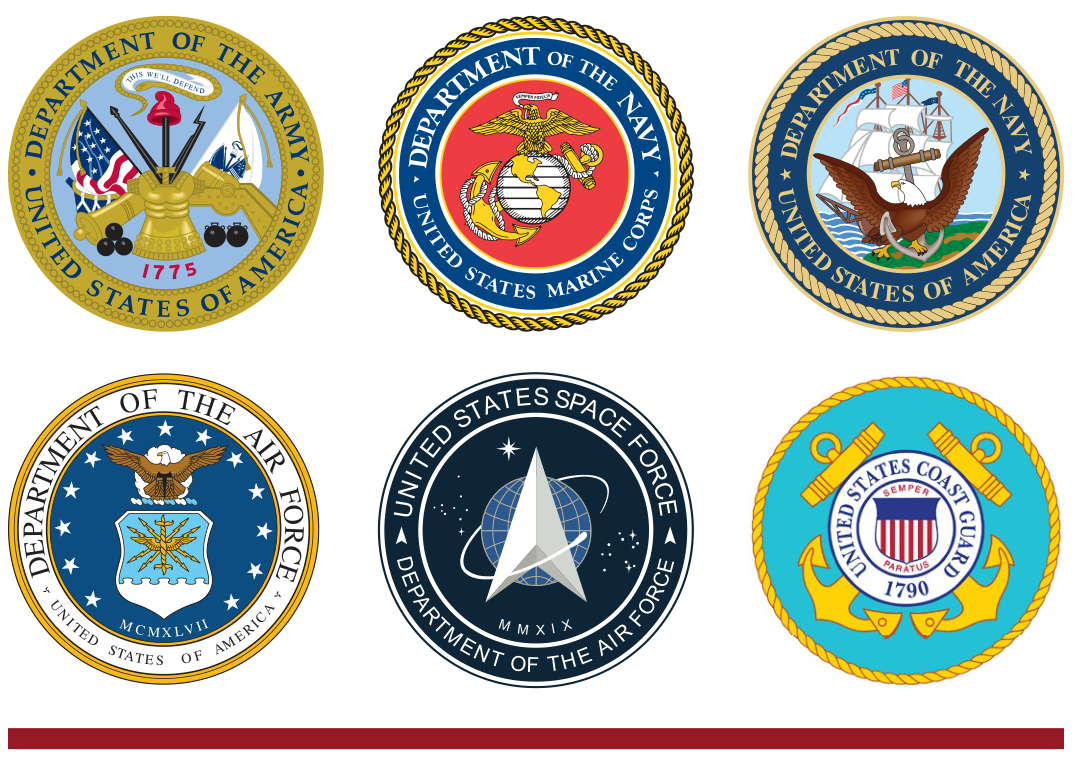
The official seals of the six branches of the U.S. Armed Forces: Army, Marine Corps, Navy, Air Force, Space Force, and Coast Guard.
A young woman cast her ballot in the 1964 presidential election. Courtesy of the Library of Congress.

VOTING FOR PRESIDENT

U.S. citizens vote for President in November, and the President is elected for four years. A person can only be elected to be President two times. This means a person can get elected for four years, and then get reelected for four more years.

When a person runs for President of the United States they are nominated by a political party. Today, there are two major political parties in the United States. One party is called the Democratic Party, and the other party is called the Republican Party.

To find the name of the President of the United States now, please visit: whitehouse.gov.

A donkey icon represents the Democratic Party.
An Elephant icon represents the Republican Party
President Donald Trump, 45th & 47th President of the United States.
President William McKinley, 25th President of the United States.

THE VICE PRESIDENT

The Vice President of the United States works for the President in the Executive Branch. The Vice President is the President of the Senate, an advisor to the President, and a member of the President’s Cabinet.

Under the Constitution, the role of the Vice President is very important. The Constitution says that if the President can no longer serve, then the Vice President becomes President. There have been some Presidents who have not served all four years of their term. For example, there are Presidents who died while serving in office. When this has happened, the Vice President becomes the President.

To find the name of the Vice President of the United States now, please visit: whitehouse.gov.

If both the President and the Vice President can no longer serve, then the Speaker of the House of Representatives becomes President.

To find the name of the current Speaker of the House, please visit: speaker.gov.

Line of Succession: President, then Vice President, then Speaker of the House.
↑ Back to chapters
CHAPTER 4

The Judicial Branch

The Judicial Branch

What you'll learn in this chapter

  • The Judicial Branch.
  • The Supreme Court.

The Judicial Branch is one branch or part of the government.

The parts of the Judicial Branch are the Supreme Court and other federal courts. The Supreme Court is the highest court in the United States. This means that the Supreme Court’s decision about a law or legal case is final. The other federal courts are sometimes called lower federal courts.

When the Founders wrote the Constitution, they did not want the judges who serve on the Supreme Court and on other federal courts to make decisions about the law based on politics or elections. Judges who serve on the Supreme Court and other federal courts are sometimes called federal judges. The Founders wanted federal judges to make decisions based on the Constitution and the rule of law. This is why federal judges are not elected to office. The President nominates someone to become a federal judge on the Supreme Court or on a lower federal court. That person must also be approved by the U.S. Senate to become a federal judge.

The process for a person to become a federal judge is an example of the separation of powers of government because all three branches of government are involved. The separation of powers is important because it stops one branch of government from becoming too powerful.
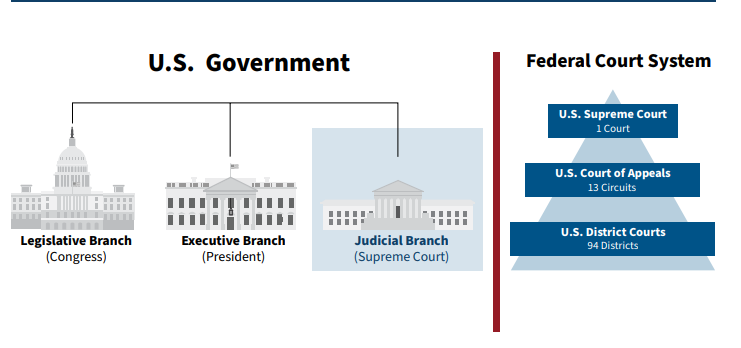
Diagram
Supreme Court Justices Clarence Thomas and Antonin Scalia.

THE JUDICIAL BRANCH

Statue of Lady Justice
Courtroom of the Supreme Court of the United States.

One of the important roles of the Judicial Branch is to review laws. This means that they can decide if a law follows the Constitution. In the United States, the Constitution is the Supreme Law of the Land. This means that everyone in the United States must follow the Constitution. This also means that the laws that Congress writes must also follow the Constitution. If someone in the United States thinks that a law does not follow the Constitution, that person can bring a legal case to a federal court to challenge the law.

Each of the courts in the Judicial Branch can only review a law if there is a legal case before it. This means that the Supreme Court and the lower federal courts can only make a decision about a law or a legal case when they have the legal authority to hear a case that is brought before the court.

The Supreme Court may review a decision about a law or legal case from a lower federal court. If the Supreme Court reviews a decision about a law or legal case, then they must make a decision. There are no other courts in the United States that can change the decision of the Supreme Court. This is one reason that the Supreme Court is the highest court in the United States.

There are nine justices on the U.S. Supreme Court.

SUPREME COURT JUSTICES

There are nine justices on the Supreme Court. The word “justice” is another word for “judge.” After the Supreme Court reviews a case, the justices meet to discuss the case and vote on the decision.

One justice on the Supreme Court is called the Chief Justice of the United States. The Chief Justice has many duties. Some of the duties are:

  • Leading the other Supreme Court justices in choosing which cases to hear.
  • Managing the courtroom when the Supreme Court is hearing a case.
  • Leading discussions with other Supreme Court justices about deciding a case.

A majority means that more than half of the justices vote the same way on a case. For example: When 9 Supreme Court Justices hear a case, at least 5 justices must vote the same on the case in order to have a majority.

The Chief Justice serves as a leader on the Supreme Court, but the justices make their own decisions when voting on each case. When a majority of the justices vote the same way on a case, they write a decision that explains their reasons.

To find the name of the current Chief Justice of the United States, please visit: supremecourt.gov/about/justices.aspx.

↑ Back to chapters
CHAPTER 5

Rights and Responsibilities

Rights and Responsibilities

What you'll learn in this chapter

  • The Bill of Rights.
  • The rights and responsibilities of U.S. citizens.
  • The rights and responsibilities of everyone living in the United States.

Under our Constitution, individuals living in the United States have rights or freedoms. The word “freedom” is another word that means “right.” Some rights belong to everyone living in the United States, and some rights only belong to U.S. citizens.

After the Constitutional Convention, the people of the United States had to approve the Constitution. Many people in the country did not like the Constitution in 1787 because it did not include a list of rights. Some of the Founders who were at the Constitutional Convention began to write essays called the Federalist Papers. The Federalist Papers supported the passage of the U.S. Constitution. The writers of the Federalist Papers were James Madison, Alexander Hamilton, and John Jay. The Federalist Papers included 85 essays about the

The Bill of Rights to the U.S. Constitution.
The Federalist Papers supported passing the U.S. Constitution.

Constitution, and they were printed in newspapers between October 1787 – May 1788. All of the writers of the Federalist Papers signed the essays with the name “Publius. The people who supported the Constitution agreed to add amendments to the Constitution that included a list of rights. An amendment is a change to the Constitution. Once the supporters of the Constitution agreed to add a list of rights, many more people in the United States decided to support the Constitution. In 1791, the first 10 amendments were added to the Constitution. They include some of the basic rights of U.S. citizens and individuals living in the United States. The first 10 amendments to the Constitution are called the Bill of Rights.

RIGHTS & FREEDOMS OF EVERYONE LIVING IN THE UNITED STATES TODAY

There are five rights or freedoms in the First Amendment.

  • 5 rights listed in the First Amendment
  • Speech
  • Religion
  • To assemble (gather)
  • The press (media)
  • To petition (write to) the government

These are rights of everyone living in the United States.

One right or freedom in the First Amendment is the Freedom of Speech. People in the U.S. have the right to say or write what they want without fear of going to jail.

People can use their Freedom of Speech to participate in American democracy. For example, people can participate in American democracy by writing to a newspaper or publicly giving their opinion about an issue or policy.

Another right or freedom in the First Amendment is the Freedom of Religion. People in the U.S. have the right to practice any religion, or not practice a religion.

The other amendments in the Bill of Rights list other types of rights. For example, the Sixth Amendment lists some of the rights for people who have been accused of breaking the law. The Sixth Amendment says that a person accused of breaking the law has the right to a trial with a jury to decide if that person is innocent or guilty.

RESPONSIBILITIES OF INDIVIDUALS LIVING IN THE UNITED STATES

Everyone living in the United States is responsible for following the “rule of law.” This means that everyone living in the United States must obey the law.

Uniform patches and identification plates from branches of the U.S. military.

For example, it is the law that everyone living in the United States must pay income taxes. The law says that each year, people are required to send in a federal income tax form to the U.S. government. The last day that people can send in their federal income tax forms is April 15.

Another responsibility for men who are U.S. citizens or legal permanent residents is to register for the Selective Service. All men who are U.S. citizens or legal residents and between the age of 18 and 26 must register for the Selective Service.

Voting booth in Atascadero, California, in 2008. Photo by Ace Armstrong. Courtesy of the Polling Place Photo Project.

VOTING IN FEDERAL ELECTIONS

In the United States, voting in federal elections is a right and a responsibility that is only for U.S. citizens. Participating in federal elections is how U.S. citizens vote for U.S. Representatives, U.S. Senators, and the President.

There are four amendments to the Constitution about who can vote in federal elections. These amendments say:

  • citizens 18 and older (can vote).
  • you don’t have to pay (a poll tax) to vote.
  • any citizen can vote (women and men can vote).
  • a male citizen of any race (can vote).

Currently, U.S. citizens 18 and older can vote in federal elections.

★ ★ ★ ★ ★ ★ ★ ★ ★ ★ ★ ★

Voting Rights Timeline

The following bullets identify the Amendments and dates that correspond with each answer choice from Q48 in the text:

  • 26th Amendment (1971)
  • 24th Amendment (1964)
  • 19th Amendment (1920)
  • 15th Amendment (1870)

Other potential dates that address the expansion of voting rights include:

  • Voting Rights Act of 1965
  • Civil Rights Act of 1964
  • Indian Citizenship Act of 1924
★ ★ ★ ★ ★ ★ ★ ★ ★ ★ ★ ★

NATURALIZATION AND U.S. CITIZENSHIP

The United States has welcomed immigrants from all over the world who have helped shape and define our country.

For more information on the eligibility requirements and process for becoming a naturalized U.S. citizen, please visit: uscis.gov/naturalization-eligibility.

When applicants for naturalization take the Oath of Allegiance, they make important promises of loyalty to the United States. The promises that applicants make when they become a United States citizen are to:

  • give up loyalty to other countries;
  • defend the Constitution and laws of the United States;
  • obey the laws of the United States;
  • serve in the U.S. military (if needed);
  • serve (do important work for) the nation (if needed); and
  • be loyal to the United States.

During the naturalization ceremony, applicants for naturalization will raise their right hand say the Oath of Allegiance. At that time, they become U.S. citizens. Naturalization is one way that a person can become a U.S. citizen. Other ways a person can become a U.S. citizen include:

  • being born in the United States, under conditions set by the 14th Amendment.
  • deriving citizenship, under the conditions set by Congress.

To become a naturalized U.S. citizen, a person must:

  • be 18 years old;
  • be a lawful permanent resident;
  • submit an application for naturalization with fees;
  • meet the residence and presence in the U.S. requirements;
  • be a person of good moral character and show attachment to the principles and ideals of the U.S. Constitution;
  • be able to read, write, speak and understand English and have knowledge and an understanding of U.S. history and government (civics);
  • complete the naturalization test and interview process; and
  • attend a naturalization ceremony and take the Oath of Allegiance
Applicants for naturalization take the Oath of Allegiance at a naturalization ceremony.
↑ Back to chapters
CHAPTER 6

U.s. Geography

U.s. Geography

What you'll learn in this chapter

  • U.S. states and territories.
  • Mountains and rivers in the United States.
  • The U.S. capital.
  • The U.S. borders.

STATES AND TERRITORIES

When the U.S. first became a country in 1776 there were 13 original states. All of the 13 original states are located on the East Coast of the United States.

Today, the U.S. has 50 states. This is why the American flag has 50 stars. There is one star for each state.

On August 21, 1959, Hawaii became the 50th state to join the United States.

The U.S. also has five territories. A U.S. territory is an area that is part of the United States, but a territory is not a state.
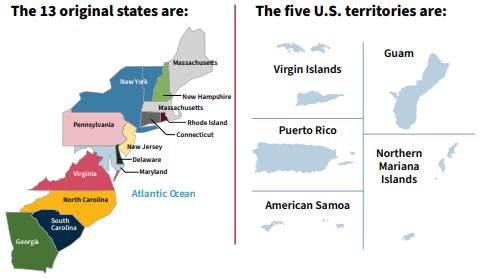
The 13 original states are shown on a map of the East Coast; the five U.S. territories are Guam, Virgin Islands, Puerto Rico, Northern Mariana Islands, and American Samoa.
Map of the 50 U.S. states, Washington, D.C., and the 5 U.S. territories, with Canada and Mexico.
This map shows the 50 U.S. states, Washington, D.C., and the 5 U.S. territories, with Canada and Mexico
There are 50 stars in the American flag for the 50 U.S. states

U.S. BORDERS

The United States is located in North America, and it is bordered by an ocean on the East Coast and the West Coast.

The U.S. is also bordered by one country to the north and another country to the south. The country that borders the U.S. to the north is called Canada. There are 13 states in the U.S. that border Canada.

The ocean on the West Coast of the United States is called the Pacific Ocean.

The ocean on the East Coast of the United States is called the Atlantic Ocean.

Map of the 50 U.S. states and Washington, D.C., with Canada and Mexico.
This map shows the 50 U.S. states and Washington, D.C., with Canada and Mexico.

The states that border Canada are:

  • Maine
  • New Hampshire
  • Vermont
  • New York
  • Pennsylvania
  • Ohio
  • Michigan
  • Minnesota
  • North Dakota
  • Montana
  • Idaho
  • Washington
  • Alaska

The country that borders the U.S. to the south is called Mexico. There are four states in the U.S. that border Mexico.

The states that border Mexico are:

  • California
  • Arizona
  • New Mexico
  • Texas

MOUNTAINS AND RIVERS

There are two large mountain ranges in the United States. The Appalachian Mountains are in the eastern United States, and the Rocky Mountains are in the western United States.

There are also many rivers in the United States. The two longest rivers in the U.S. are the Mississippi River and the Missouri River. The Mississippi River runs north to south, and it is located in the middle of the country. The Missouri River connects to the Mississippi River, and it runs across several states in the West.

Map showing the Rocky Mountains, Appalachian Mountains, Mississippi River, and Missouri River.
This map shows the two longest rivers, the Mississippi River and the Missouri River.

WASHINGTON D.C.

The capital of the United States is called Washington, D.C.

Washington, D.C., is named after George Washington. George Washington was the first President of the United States. He is also known as the “Father of Our Country”.

The name of the capital has the letters “D.C.” These letters mean “District of Columbia.” Washington, D.C., is not part of a state. Washington, D.C., is located between the states of Maryland and Virginia, and it is controlled by the federal government.

Each state in the United States also has a state capital. Use the map below to find the capital of your state.
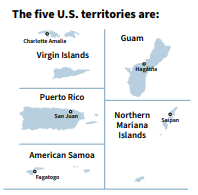
The five U.S. territories are: Virgin Islands (Charlotte Amalie), Guam (Hagåtña), Puerto Rico (San Juan), Northern Mariana Islands (Saipan), and American Samoa (Fagatogo).
Map of the 50 U.S. states showing each state capital.
This map shows the 50 U.S. states and Washington, D.C.
↑ Back to chapters
CHAPTER 7

Early American History

Early American History

What you'll learn in this chapter

  • Early American History.
  • The people living in the North America before 1776.
  • The Colonial Period (1607 – 1776).

EUROPEAN COLONIES

In the 1400s, some European countries developed ships that could sail across the ocean. Spain was the first country to send ships across the Atlantic Ocean.

They did not know that the continents of North America and South America were between Europe and Asia. North and South America are sometimes called the Americas.

The Europeans also did not know that there were millions of people living in North and South America. The people living in the Americas before the Europeans arrived are called Native Americans.

By the 1500s, Spain had created colonies across North America and South America. Soon, other European countries like France, Portugal, and England started creating their own colonies in the Americas.

NATIVE AMERICANS

Native Americans lived in North and South America for around 20,000 years before the Europeans arrived.

There were many different tribes of Native American people living in the Americas. Each Native American tribe had their own culture, religion, traditions, language, and form of government. Many tribes moved around and relied on hunting and gathering for food. There were also tribes that stayed in one place and relied on farming for food. Some tribes lived in large cities and had complex forms of government and written languages.

Illustration of the town of Pomeiock by John White. Courtesy of the Jamestown Yorktown Foundation collection.

Before the Europeans arrived, there were more than 50 million Native Americans living in North and South America. More than 10 million Native Americans lived on the land in North America that became the United States. After Europeans arrived in North and South America, millions of Native Americans died from diseases brought by Europeans. Many Native Americans also died from wars and conflicts with Europeans.

By the 1600s, there were about 6 million Native Americans living in the Americas, and about 1 million Native Americans still living in North America.

THE COLONIAL PERIOD (1607 – 1776)

A scene of a busy street in Jamestown around 1650. Courtesy of the National Park Service.

In 1607, the country of England created its first permanent settlement in North America. It was called Jamestown. This started the period in American history called the Colonial Period. It lasted from 1607 – 1775. During the Colonial Period, England created 13 colonies in North America.

Many colonists who settled in Jamestown came to North America because they wanted economic opportunities. Some colonists believed that it would be easier to buy land for farming in North America. Others thought they could find valuable metals like gold and silver.

The first years in Jamestown were difficult for the colonists. Many died from hunger, disease, or the cold winter weather. Colonists and Native Americans also fought over who would control the land. Both colonists and Native Americans died during the fighting.

SLAVERY IN THE COLONIES

An image of the first enslaved people from Africa arriving in Jamestown.

After the first few years, the colonists in Jamestown began to have more success, and the number of colonists grew. They moved to new areas and started growing crops like tobacco and later cotton. The colonists made a lot of money selling these crops to England. They wanted to grow more crops, but they did not have enough people to work on the farms.

Other European countries that had colonies took people from Africa to the Americas and sold them as slaves. Another term for “slave” is an “enslaved person.” An enslaved person is someone who is forced to work with no freedom. Millions of enslaved African people were forced on ships and taken to North and South America.

The first group of enslaved Africans were brought to Jamestown in 1619. Enslaved Africans were forced to work on farms in terrible conditions.

Map showing the routes that colonists from Europe made when coming to North America and the routes that brought enslaved people from Africa to North America and South America.
This map shows the routes that colonists from Europe made when coming to North America and the routes that brought enslaved people from Africa to North America and South America.

THE 13 ORIGINAL COLONIES

“Pilgrims Going to Church,” by George Henry Boughton. Courtesy of the Library
 of Congress.
“Pilgrims Going to Church,” by George Henry Boughton. Courtesy of the Library of Congress.

As more colonists came to Jamestown, they started to create other settlements. Soon these settlements became known as the colony of Virginia.

In 1620, a group of English colonists called the Pilgrims created the colony of Massachusetts. Many of these colonists came to North America because they wanted religious freedom.

Soon more colonists from England began coming to North America and created more colonies. They created 13 colonies on the East Coast of North America.

The Colonial Period ended when the colonists living in the 13 original colonies declared their independence from Great Britain in 1776.

When the Colonial Period started in 1607, the colonists were part of the country of England. England is on the island of Britain. The country of Scotland is also on the island of Britain. In 1707, England and Scotland became one country called Great Britain. After 1707, the 13 original colonies were part of Great Britain.

The 13 original colonies were:
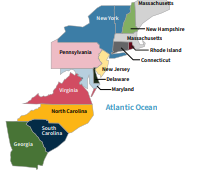
  • New Hampshire
  • Massachusetts
  • Rhode Island
  • Connecticut
  • New York
  • New Jersey
  • Pennsylvania
  • Delaware
  • Maryland
  • Virginia
  • North Carolina
  • South Carolina
  • Georgia
Map of the 13 original colonies on the East Coast of North America.
↑ Back to chapters
CHAPTER 8

The American Revolutionary War & the Declaration of Independence

The American Revolutionary War & the Declaration of Independence

What you'll learn in this chapter

  • The American Revolutionary War.
  • The creation of the United States of America.
  • The Declaration of Independence.

CAUSES OF THE AMERICAN REVOLUTIONARY WAR

In 1775, the colonists went to war with Great Britain. This war was called the American Revolutionary War. During the American Revolutionary War, the colonists declared their independence from Great Britain, and they created the United States of America. The American Revolutionary War started in 1775. It ended in 1783 when Great Britain signed a treaty that said they agreed that the United States was an independent country.

The reason the colonists fought the British was because they did not have self-government.

When the colonists created the 13 colonies, each colony had its own colonial congress. A colonial congress was a legislative branch that made laws for each colony.

Great Britain allowed the colonies to have a colonial congress as long as they paid taxes to Great Britain, obeyed all other British laws, and provided Great Britain with materials like cotton, tobacco, and rice.

In the 1760s, Great Britain was fighting a war both in Europe and in North America. Great Britain needed help paying for the war. They passed laws that increased taxes on the 13 original colonies. The colonists did not think it was fair that Great Britain raised their

“Washington Taking Command of the American Army,” by Currier & Ives. Courtesy of the National Archives, 532915.

taxes without allowing representatives from the colonies to vote on it. Many colonists began to protest against the taxes because they thought it was not fair to have taxation without representation.

“George Washington at Princeton,” by Charles Willson Peale. Courtesy of the U.S. Senate.

Great Britain responded by passing laws to punish the colonists. Great Britain made the colonists pay more taxes and made the colonial congresses illegal. These taxes and laws made the colonists even angrier. Many colonists no longer wanted to be part of Great Britain. They wanted to create their own country and govern themselves.

In 1775, colonists in Massachusetts began fighting the British. Soon, all 13 original colonies were fighting against Great Britain. The colonists created an army, and George Washington was named the general of the colonial army during the American Revolutionary War. This is one reason that George Washington is called the “Father of Our Country”.

THE DECLARATION OF INDEPENDENCE

The Declaration of Independence was adopted on July 4, 1776. The Declaration of Independence announced our independence from Great Britain. This is why we celebrate Independence Day on July 4th.

The Declaration of Independence. Courtesy of the National Archives.

Another word for “Declaration” is “statement.” Another word for “Independence” is “freedom.” The Declaration of Independence is a “statement of freedom.”

Thomas Jefferson wrote the Declaration of Independence. In the Declaration of Independence, Thomas Jefferson wrote that everyone has the right to:

  • life;
  • liberty; and
  • the pursuit of happiness.
In “Declaration of Independence,” by John Trumbull, Thomas Jefferson and his committee present the formal statement of independence from Great Britain. Courtesy of the National Archives.
Assembly room of Independence Hall where the Declaration of Independence and the U.S. Constitution were both signed. Courtesy of the National Park Service.

When the colonists adopted the Declaration of Independence, they created the United States of America. The 13 original colonies became the 13 original states.

The 13 original states are:

  • New Hampshire
  • Massachusetts
  • Rhode Island
  • Connecticut
  • New York
  • New Jersey
  • Pennsylvania
  • Delaware
  • Maryland
  • Virginia
  • North Carolina
  • South Carolina
  • Georgia
Map of the 13 original states on the East Coast of North America.

WINNING THE AMERICAN REVOLUTIONARY WAR

The United States stopped fighting with Great Britain in 1781. The British Army surrendered to the United States at the Battle of Yorktown in the state of Virginia. There was no more fighting, but the American Revolutionary War did not officially end until the U.S. and Great Britain signed a treaty in 1783. In the treaty, Great Britain agreed that the United States won the American Revolutionary War and that the United States was an independent nation.

American, British and Hessian soldiers fight furiously at the Siege of Yorktown. Courtesy of the Library of Congress.

Benjamin Franklin was a Founder who was famous for many things. One thing Benjamin Franklin was famous for was being a diplomat. A “diplomat” is someone who travels to other countries to represent the United States. Benjamin Franklin was the diplomat who negotiated the treaty with Great Britain in 1783.

Benjamin Franklin
Benjamin Franklin

Other answer choices for this question:

  • Oldest member of the Constitutional Convention
  • Writer of Poor Richard’s Almanac
  • Started first free libraries
  • First Postmaster General of the United States
↑ Back to chapters
CHAPTER 9

A New Government and an Expanding Nation

A New Government and an Expanding Nation

What you'll learn in this chapter

  • The Constitutional Convention.
  • The expansion of U.S. territory from the Atlantic Ocean to the Pacific Ocean.
  • The conflicts caused by expansion.

THE CONSTITUTIONAL CONVENTION

The Constitution was written in 1787. It was written 11 years after the Declaration of Independence was adopted in 1776.

After the United States won the American Revolutionary War, many people were not happy with the way the country was being governed. Many of the states disagreed on issues like trade, taxes, and other laws.

Some of the country’s leaders like George Washington, Alexander Hamilton, and James Madison believed that the United States needed a new government.

In 1787, leaders from all the 13 original states met in Philadelphia, Pennsylvania to create a new government. This meeting was called the Constitutional Convention. The Founders wrote the Constitution at the Constitutional Convention.

After the Founders wrote the Constitution, the 13 original states had to vote for the Constitution.

Not everyone in the country wanted the new Constitution. James Madison, Alexander Hamilton, and John Jay wrote papers to support passing the U.S. Constitution. These papers are called the Federalist Papers. They published the Federalist Papers in newspapers across the United States.

When the states voted to pass the Constitution, the United States created a new government. When the new government was created, George Washington was elected the first President of the United States. He served as President from 1789 – 1797. George Washington is also known as the “Father of Our Country”.

George Washington takes the Oath of Office at Federal Hall in New York City.
The Federalist Papers supported passing the U.S. Constitution.
The Constitution of the United States. Courtesy of the National Archives.

THE U.S. BETWEEN 1787 – 1803

When the Constitution was written in 1787, the U.S. had 13 states on the East Coast of North America. The United States also claimed to own the land between the 13 original states and the Mississippi River as U.S. territory. The word “claim” means that other European countries that created colonies in the Americas agreed that this territory was owned by the United States.

At this time, there were still over 600,000 Native Americans living on the land claimed by the United States. Native American tribes had lived for thousands of years in the territory that the U.S. claimed. They did not agree that the U.S. owned the land. This led to many conflicts and wars in the 1800s because Native Americans were forced to defend their people, their culture, and their land.

THE LOUISIANA TERRITORY

In 1803, the United States purchased the Louisiana Territory from France. The Louisiana Territory included a large amount of land between the Mississippi River and the Rocky Mountains. France sold the Louisiana Territory to the United States because they needed money to pay for wars they were fighting in Europe.

This map shows the U.S. in 1803 in green and the Louisiana Territory in pink.

When the U.S. purchased the Louisiana Territory from France, more people began moving west into the new territory. This led to more conflicts and wars between people from the United States and Native Americans.

For example, between the 1830s – 1850s, people from five Native American nations in the southern United States were forced to move from their homeland to land in the Louisiana Territory. The five Native American nations were the Cherokee, Muscogee, Seminole, Chickasaw, and Choctaw. This event is called the “Trail of Tears” because thousands of people died from disease and starvation on the trail during the journey.

Throughout the 1800s, people from the United States continued to move West. This led to more conflicts between Native Americans and people from the U.S., and more Native Americans were forced to move off their land.

Native Americans are also called American Indians. Today, there are over 500 American Indian tribes in the United States.

This map shows the U.S. in the 1850s.
This map shows the journey that Native Americans were forced to take during the Trail of Tears.

Some of the American Indian tribes in the United States are:

  • Cherokee
  • Navajo
  • Sioux
  • Chippewa
  • Choctaw
  • Pueblo
  • Apache
  • Iroquois
  • Creek
  • Blackfeet
  • Seminole
  • Cheyenne
  • Arawak
  • Shawnee
  • Mohegan
  • Huron
  • Oneida
  • Lakota
  • Crow
  • Teton
  • Hopi
  • Inuit

THE MEXICAN-AMERICAN WAR

In 1845, Texas became the 28th state to join the United States. Until 1836, Texas was part of Mexico. Texas fought for independence from Mexico and became its own country from 1836 – 1845.

Colonel Charles May’s troops charge at the Battle of Resaca de la Palma during the Mexican-American War.

At that time, Mexico still claimed much of the land in the southwest between the Rocky Mountains and the Pacific Ocean. Mexico also wanted Texas to be part of Mexico again.

In 1846, the U.S. went to war with Mexico over Texas and other land that Mexico controlled in the southwest. This war is called the Mexican- American War.

The Mexican-American War was one war fought by the United States in the 1800s.

The U.S. won the Mexican-American War in 1848. After the war, the United States and Mexico signed a treaty. In the treaty, Mexico agreed that Texas was part of the United States. Mexico also agreed to sell the land it claimed in the southwest to the U.S. The territory the U.S. gained from Mexico later became the states of California, Nevada, and Utah. It also included territory that became parts of the states of Arizona, Colorado, New Mexico, and Wyoming.

Other wars that the United States fought in the 1800s include:

  • War of 1812
  • Civil War
  • Spanish-American War

Today, the states of California, Arizona, New Mexico, and Texas all border Mexico.

This map shows the United States after the Mexican-American War.

EXPANDING INTO THE WEST

In 1850, California became the 31st state to join the United States, and it was the first state to join the United States that bordered the Pacific Ocean.

By 1860, there were 33 states in the United States. The Atlantic Ocean bordered the U.S. on the East Coast, and the Pacific Ocean bordered the U.S. on the West Coast. The U.S. also claimed all of the land between Canada and Mexico that today makes up the first 48 states to join the United States.

The growth of the country not only led to conflicts with Native Americans and Mexico, it also led to conflicts between people from the United States moving to the West. The biggest conflict was over slavery.

Other answer choices for this question:

The conflicts over slavery in the South and the West were one problem that led to the Civil War.

  • economic reasons
  • states’ rights
↑ Back to chapters
CHAPTER 10

The Civil War

The Civil War

What you'll learn in this chapter

  • Slavery during the 1800s.
  • Abraham Lincoln.
  • The Civil War.
  • The end of slavery in the U.S.

SLAVERY IN THE 1800S

During the 1800s, the states in the southern United States began to depend more on growing cotton and other crops for sale to countries in Europe. Landowners depended on enslaved people to do the work.

As the U.S. gained more territory, many people who owned slaves in the South wanted to move to the new states and territories in the West. They wanted to find more land to grow crops like cotton, corn, and tobacco. They also wanted slavery to be legal in the West so they could bring enslaved people to work on the farms and grow crops.

Most northern states passed laws against slavery, and many people in the North did not want slavery to be legal in the West. When people from the North and the South began moving west in the 1800s, there were many conflicts about whether slavery should be legal in the new states and territories. Congress began to pass laws that said where slavery was legal in the West and where it was not.

Picking cotton on a Georgia plantation. Courtesy of the Library of Congress.

FIGHTING FOR CIVIL RIGHTS AND FIGHTING TO END SLAVERY

Between 1800 -1860 there were people who thought that slavery should be illegal and that everyone in the U.S. should have civil rights. For example, Frederick Douglass escaped from slavery and became an important civil rights leader in the 1800s. He is famous for giving speeches and writing books about ending slavery and protecting civil rights for all people.

Frederick Douglass. Courtesy of the National Park Service.
Susan B. Anthony. Courtesy of the Library of Congress.

Susan B. Anthony is another person who fought for civil rights during the 1800s. She agreed with Frederick Douglass that slavery should be illegal. Susan B. Anthony also fought for women’s rights. She wanted women to be treated equally to men, and she wanted women to have the right to vote in the United States.

THE BEGINNING OF THE CIVIL WAR

In 1861, the U.S. started fighting the Civil War. The Civil War is one war that the U.S. fought during the 1800s. The Civil War was fought between the North and the South between 1861 – 1865.

One problem that led to the Civil War was slavery. The states in the South believed that slavery should be legal. They were afraid that states in the North wanted to make slavery illegal in the whole country. The states in the North were also afraid that the Southern states wanted to make slavery legal in the whole country.

The Civil War started in 1861 after 11 states in the South left the United States and tried to create their own country. They called their country the Confederate States of America. The states in the North were still called the United States of America.

Civil War Battle of Antietam.
The United States in 1861, at the start of the Civil War.

ABRAHAM LINCOLN

Abraham Lincoln
Abraham Lincoln

Abraham Lincoln led the United States during the Civil War. He was the 16th President of the United States, and he served as President from 1861 – 1865.

“Emancipation,” by Thomas Nast. Courtesy of the Library of Congress

During the Civil War, Abraham Lincoln signed the Emancipation Proclamation. The Emancipation Proclamation freed the slaves in most Southern states. “Emancipation” is another word for “freedom.” “Proclamation” is another word for “announcement.” The Emancipation Proclamation announced that people who were enslaved in most Southern states were free. Most people enslaved in Southern states were not actually freed until after the Civil War was over.

The North won the Civil War when the South surrendered in April 1865. A few days after the South surrendered to the North, Abraham Lincoln was assassinated. The word “assassinated” means that a person is murdered for political reasons.

Abraham Lincoln visits a battlefield during the Civil War.

THE END OF SLAVERY

After the Civil War was over, all the people who were enslaved in Southern states were freed. On June 19, 1865, enslaved people living in Galveston, Texas, became the last to learn that the Civil War was over and that they were free. June 19th became a holiday called Juneteenth. Today, Juneteenth is a national U.S. holiday that recognizes and celebrates the end of slavery in the United States.

On December 6, 1865, the 13th Amendment was added to the Constitution. An amendment is a change to the Constitution. The 13th Amendment says that slavery is illegal in the United States.

↑ Back to chapters
CHAPTER 11

American History: 1900-2001

American History: 1900-2001

What you'll learn in this chapter

  • The wars the U.S.
  • The Great Depression.
  • The Civil Rights Movement.

fought in the 1900s.

  • The Cold War.
  • September 11, 2001.

By the 1900s, more people in the United States were moving to cities to work in factories, and immigrants from all over the world were moving to the U.S. The United States’ economy was starting to grow, and soon the U.S. would begin to increase the size of its military.

Rubber-making factories on a river in 1897. Courtesy of the Library of Congress.

WORLD WAR I

American soldiers in a trench in France during World War I. Courtesy of the Library of Congress.

In 1914, a war started in Europe. When the war started, it was called The Great War. Today, the Great War is called World War I. There were many countries fighting on each side of the war during World War I.

World War I is one war fought by the United States in the 1900s. World War I was fought by countries from around the world from 1914 – 1918, but the U.S. did not join the war until 1917. The U.S. fought in World War I from 1917 – 1918.

World War I ended on November 11, 1918. Today, we celebrate Veterans’ Day every November 11 in honor of the men and women (alive and deceased) who have served in the military. Veterans’ Day is a national U.S. Holiday.

Woodrow Wilson was President during World War I. Woodrow Wilson was the 28th President of the United States, and he was President from 1913 – 1921.

Two sailors read a newspaper with the headline “Great War Ends.” Courtesy of the Library of Congress.

Other wars that the United States fought in the 1900s include:

  • World War II
  • Korean War
  • Vietnam War
  • (Persian) Gulf War

THE GREAT DEPRESSION

When President Roosevelt was elected in 1933, the U.S. was in the Great Depression. The Great Depression was the worst time for the U.S. economy in American history.

The economic system in the United States is called a “capitalist economy”. It is also sometimes called a “market economy. In a market economy, the government does not control the economy. Also, people are free to start a business and make money.

The Great Depression had terrible effects on the American economy. During the Great Depression, banks and businesses around the country closed, and many people could not a get a job. A lot of people in the U.S. lost their homes and their money.

Statue of a Depression breadline at the Franklin Delano Roosevelt Memorial, Washington, D.C. Courtesy of the Library of Congress.
A migrant agricultural worker’s family during the Great Depression. Photograph by Dorothea Lange. Courtesy of the Library of Congress.

FRANKLIN ROOSEVELT

In 1933, Franklin Roosevelt was elected the 32nd President of the United States. Franklin Roosevelt was the longest-serving President in U.S. history, and he was elected President four times. He was President from 1933 – 1945, and he died while serving as President in 1945. In 1951, the 22nd amendment was added to the Constitution. An amendment is a change to the Constitution. The 22nd Amendment says a person can only be elected President two times.

Franklin Roosevelt was President during two important periods in American history. He was President during the Great Depression and World War II.

President Franklin D. Roosevelt signing the Declaration of War against Japan on December 8, 1941. Courtesy of the National Archives.

WORLD WAR II

In 1939, World War II started when Germany attacked Poland. Germany then began to attack other European countries. Japan and Italy agreed to fight on the same side as Germany.

World War II was one war that the U.S. fought in the 1900s. The U.S. fought in World War II from 1941 – 1945.

On December 7, 1941, Japan attacked the United States at a U.S. naval base in Hawaii called Pearl Harbor. On December 8, President Roosevelt announced that the U.S. would enter World War II. Later that day, Congress voted to declare war. The power to declare war is one power that belongs to the federal government under the Constitution.

During World War II, the U.S. fought Japan, Germany, and Italy.

The U.S. did not fight these countries alone. The United Kingdom, France, Russia, and other countries fought against Japan, Germany, and Italy. World War II ended in 1945 when Germany and Japan surrendered.

Bombing of USS West Virginia, Pearl Harbor, Hawaii. Courtesy of the Library of Congress.

THE COLD WAR

General Dwight D. Eisenhower, 1945. Courtesy of the National Archives.
Astronaut Edwin E. Aldrin Jr., on the Moon. Courtesy of NASA.

When the United States fought in World War II, the U.S. and Russia fought on the same side. Russia controlled many nearby countries. Russia, and the countries it controlled, were called the Soviet Union. The U.S. and the Soviet Union did not trust each other. After World War II, the United States and the Soviet Union became involved in the Cold War.

During the Cold War, the main concern of the United States was the spread of communism. Communism is a type of government in which the government plans the economy and controls most of the resources. Also, in most communist countries, the government is controlled by one political party. Russia and all the countries in the Soviet Union were communist. Other countries like China and North Korea were also becoming communist. The U.S. wanted to stop other countries around the world from becoming communist.

The Cold War did not have soldiers from the U.S. and the Soviet Union fighting each other in battles. Instead, the U.S. and the Soviet Union had diplomats and spies who used information and threats against each other.

In 1953, Dwight Eisenhower became the 34th President of the United States. He served from 1953 – 1961. Before he was President, Eisenhower was a general in World War II. While he was President, the U.S. and the Soviet Union were building large armies in case they went to war. The U.S. and the Soviet Union also began trying to send rockets into space. In 1957, the Soviet Union became the first country to send a satellite into space. In 1969, the U.S. became the first country to land a person on the moon.

The Cold War ended in 1991 when the Soviet Union collapsed.

Map showing the United States and the Soviet Union during the Cold War.
This map shows the United States and the Soviet Union during the Cold War.

THE CIVIL RIGHTS MOVEMENT

Dr. Martin Luther King, Jr., civil rights leader.
Dolores Huerta, civil rights leader.
The March on Washington in 1963.

During the 1900s, many states had laws that discriminated against people based on their race. Some of these laws said that people of different races had to go to separate schools, eat in separate restaurants, and live in separate neighborhoods. Other laws made it difficult for people to vote based on their race. Many of the states that had these laws wanted to separate Black Americans from White Americans. Some states had laws that discriminated against Latino Americans and Asian Americans.

Soon after World War II ended, many people in the United States began a movement to end racial discrimination. The movement to end racial discrimination in the United States is called the Civil Rights Movement. During the Civil Rights Movement, many people worked to end the laws that separated people based on their race or made it difficult for people to vote based on their race. For example, Martin Luther King, Jr., fought for civil rights. He was a leader in the Civil Rights Movement who organized peaceful protests against racial discrimination and laws that separated people by race. A lot of his work focused on fighting for civil rights for Black Americans, but he wanted all people in the United States to have civil rights.

There were also many Latino Americans, Asian Americans, and people from other communities that helped lead the fight for civil rights. For example, Cesar Chavez and Dolores Huerta were civil rights leaders from the Latino American community.

The Civil Rights Movement led to many changes in the United States. Martin Luther King, Jr., and other civil rights leaders were able to convince Congress to pass two laws that protect civil rights and voting rights. In 1964, Congress passed a law called the Civil Rights Act. This law says it is illegal to discriminate against someone based on their race, religion, sex, or national origin. In 1965, Congress passed another law called the Voting Rights Act. This law says that states cannot deny people the right to vote based on their race.

Today, Martin Luther King, Jr. Day is a national holiday. We celebrate Martin Luther King, Jr. Day on the third Monday in January.

SEPTEMBER 11, 2001

Firefighters unfurl a large American flag over the scarred stone of the Pentagon on September 12, 2001. White House photo by Paul Morse.

On September 11, 2001, terrorists attacked the United States. Terrorists hijacked four airplanes. Two airplanes crashed into the World Trade Center in New York City. One plane crashed into the Pentagon in Arlington, Virginia, near Washington, D.C. The passengers on the fourth plane fought the terrorists and the plane crashed in Shanksville, Pennsylvania.

Almost 3,000 people died in the September 11th terrorist attacks. The September 11, 2001, terrorist attacks were the worst attacks on the United States’ homeland since Japan attacked Pearl Harbor in 1941.

Rescue workers amid debris following September 11th terrorist attack on World Trade Center, New York City.
↑ Back to chapters
CHAPTER 12

American Symbols and Holidays

American Symbols and Holidays

What you'll learn in this chapter

  • The Statue of Liberty.
  • The national anthem.
  • The American flag.
  • National holidays that have special meaning in the United States.

AMERICAN SYMBOLS

The Statue of Liberty

The Statue of Liberty is a famous symbol of the United States. In 1886, France gave the statue to the United States as a symbol of friendship.

It is a symbol of freedom and democracy. The Statue of Liberty is in New York Harbor on Liberty Island. Every year, over 4 million people from around the world visit the Statue of Liberty.

The statue is of a woman holding a torch in her right hand and a tablet in her left hand. The tablet has the date July 4, 1776, on it. July 4, 1776, is when the Declaration of Independence was adopted.

Statue of Liberty. Courtesy of the Library of Congress.

Ellis Island

Ellis Island was an immigration station in New York Harbor. Ellis Island began receiving immigrants to the United States on January 1, 1892. Over the next 62 years, more than 12 million immigrants arrived in the United States through Ellis Island. Currently the Statue of Liberty and Ellis Island are National Historic Sites. For more information on the Statue of Liberty and Ellis Island, please visit: nps.gov/stli.

Immigration station at Ellis Island.
Great Hall at Ellis Island immigration station.

Angel Island

Angel Island was another important immigration station on the West Coast. The Pacific Ocean is on the West Coast of the United States. Between 1910 and 1940, Angel Island processed nearly 1 million immigrants that crossed the Pacific Ocean. Many Asian Americans can trace their family history through Angel Island.

Immigration Station on Angel Island.

The American Flag

The American flag is an important symbol of the United States. Like the Statue of Liberty, it is also a symbol of freedom. The colors of the flag are red, white, and blue. Each color on the flag has a meaning:

  • Red is a symbol for bravery.
  • White is a symbol for purity.
  • Blue is a symbol for justice.

The flag has 13 red and white stripes. The stripes represent the 13 original colonies.

There are 50 stars on the flag. Each star represents a state.

The American flag.
The American flag.

The Pledge of Allegiance

Students recite the Pledge of Allegiance.

We show loyalty to the flag and the United States when we say the Pledge of Allegiance.

During naturalization ceremonies, everyone attending the ceremony is asked to say the Pledge of Allegiance. When we say it, we stand, turn toward the flag, and put our right hand over our heart.

The National Anthem

In “The Star-Spangled Banner,” by Percy Moran, Francis Scott Key reaches toward the flag flying over Fort McHenry.

The name of the national anthem is “The Star-Spangled Banner”.

“Spangled” refers to the stars on the flag that look like they are shining in night sky. The word “banner” means flag.

The Star-Spangled Banner was written by Francis Scott Key. He wrote it about seeing the American flag after a battle during the War of 1812. The War of 1812 was one war the U.S. fought in the 1800s.

AMERICAN HOLIDAYS

The following holidays are national holidays. National holidays are sometimes called “federal holidays” because they were passed by Congress and signed into law by the President.

The following federal holidays relate to other content from the 128 Civics Questions and Answers.

Martin Luther King, Jr. Day (Third Monday in January)

Martin Luther King, Jr. Day is a day that we honor the life and work of Martin Luther King, Jr.

Martin Luther King, Jr., was a church and community leader. He fought for civil rights by working to protect the rights of individuals listed in the Bill of Rights. For example, Martin Luther King, Jr. believed that everyone should have rights and freedoms listed in the First Amendment. The First Amendment protects freedom of worship, speech, the press, assembly, and the right to ask the government for a change.

Martin Luther King, Jr., led many of the events during the civil rights movement. The civil rights movement tried to end racial discrimination. In 1963, Martin Luther King, Jr., led the March on Washington for Jobs and Freedom. He gave his famous “I Have a Dream” speech in front of the Lincoln Memorial.

In 1965, Martin Luther King, Jr., and other civil rights leaders, like John Lewis, helped to organize a march from Selma, Alabama, to Montgomery, Alabama. They organized the march to support voting rights for all U.S. citizens. Soon after the march from Selma to Montgomery, Congress passed a law called the Voting Rights Act of 1965.

Martin Luther King, Jr., was awarded the Nobel Prize for Peace in 1964. He was assassinated on April 4, 1968.

The third Monday in January is Martin Luther King, Jr. Day. It is a national holiday. There is also a memorial in Washington, D.C., to honor him.

Martin Luther King, Jr., gave his famous “I Have a Dream” speech at the Lincoln Memorial in 1963.

Presidents’ Day (Third Monday in February)

We celebrate Presidents’ Day to honor George Washington and Abraham Lincoln.

George Washington was the first president of the United States. He is also called the “Father of Our Country. President Washington was born on February 22.

Abraham Lincoln was the 16th President of the United States. He led the United States during the Civil War. President Lincoln was born on February 12.

We celebrate Presidents’ Day on the third Monday in February because it is between President Washington’s birthday and President Lincoln’s birthday.

“George Washington at Princeton,” by Charles Willson Peale. Courtesy of the U.S. Senate.
Abraham Lincoln. Courtesy of the Library of Congress.
★ ★ ★ ★ ★ ★ ★ ★ ★ ★ ★ ★ ★ ★ ★ ★

U.S. Holidays

  • New Year’s Day (January 1).
  • Birthday of Martin Luther King, Jr. (Third Monday in January).
  • Washington’s Birthday or Presidents’ Day (Third Monday in February).
  • Memorial Day (Last Monday in May).
  • Juneteenth National Independence Day (June 19).
  • Independence Day (July 4).
  • Labor Day (First Monday in September).
  • Columbus Day (Second Monday in October).
  • Veterans Day (November 11).
  • Thanksgiving Day (Fourth Thursday in November).
  • Christmas Day (December 25).
★ ★ ★ ★ ★ ★ ★ ★ ★ ★ ★ ★ ★ ★ ★ ★

Memorial Day (Last Monday in May)

Arlington National Cemetery
A member of the U.S. Army honor guard walks past the Tomb of the Unknown Soldier at Arlington National Cemetery.

Memorial Day honors men and women who died in service to the United States. Memorial Day is the last Monday in May.

Memorial Day was originally called Decoration Day, from decorating graves with flowers, wreaths, and flags. People in the United States started to observe Memorial Day more widely soon after the Civil War. The Civil War was one war the U.S. fought in the 1800s.

Today, Memorial Day is a national holiday. It is commemorated at Arlington National Cemetery each year with a ceremony in which a small American flag is placed on each grave. We also fly the American flag at half-staff to honor those who died in service to the United States.

Juneteenth (June 19)

Juneteenth is a national holiday that recognizes the end of slavery in the United States.

In 1863, President Abraham Lincoln issued the Emancipation Proclamation. The Emancipation Proclamation said the enslaved people in the Southern states were free. Slavery did not actually end until the Civil War ended in 1865. On June 19, 1865, enslaved people in Galveston, Texas, became the last to learn that they were free. This is why June 19th is called Juneteenth.

Independence Day (July 4)

Independence Day, or the Fourth of July, celebrates the Declaration of Independence, or the birth of the nation.

Independence Day celebrations at
 Independence Hall in Philadelphia, Pennsylvania.
Independence Day celebrations at Independence Hall in Philadelphia, Pennsylvania.

The Declaration of Independence announced America’s independence from Britain. Thomas Jefferson wrote the Declaration of Independence as a statement of freedom from unfair treatment from Great Britain. The Declaration of Independence was adopted on July 4, 1776.

The Declaration of Independence highlights the importance of self- government in the United States. It also inspired many countries around the world to declare their own freedom.

Every year we celebrate Independence Day on July 4.

Military honor guard at a Veteran’s Day parade.

Veterans Day (November 11)

“Raising the Flag on Iwo Jima,” photographed by Joe Rosenthal.
 Courtesy of the Associated Press, 1945.
“Raising the Flag on Iwo Jima,” photographed by Joe Rosenthal. Courtesy of the Associated Press, 1945.

Veterans Day is a national holiday when we honor individuals who have served in the U.S. Armed Forces (alive or deceased) in service of the United States.

Veterans Day was originally called Armistice Day and celebrated the end of World War I, which ended on November 11, 1918. World War I is one war the U.S. fought in the 1900s. Woodrow Wilson was the President of the United States during World War I. Armistice Day was officially recognized by U.S. President Woodrow Wilson in 1919. It began to be observed throughout the world, honoring those who fought to end of the “Great War.”

In 1954, U.S. veterans asked Congress to write a law that changed the name of Armistice Day to Veterans Day. The U.S. Congress makes federal laws. On June 1, 1954, Congress passed a law for Veterans Day to be a national holiday to honor men and women (alive or deceased) who have served in the U.S. military.

Today, we celebrate Veterans Day each year on November 11.

Thanksgiving (Fourth Thursday in November)

Thanksgiving is a national U.S. holiday that is celebrated on the fourth Thursday in November. Thanksgiving celebrates a harvest meal shared by Native Americans and English colonists in 1621. In November 1621, English colonists were trying to create a colony in Massachusetts. A Native American tribe called the Wampanoag gathered with the colonists in the fall for a harvest feast.

Today, the people in the United States gather with family and friends on Thanksgiving to share a meal and reflect on the reasons why they are thankful.

An early Thanksgiving celebration.
↑ Back to chapters
APPENDIX

128 Civics Test Questions and Answers

The complete official list. Any answer marked with an asterisk in the source guide may change with elected officials check uscis.gov/citizenship/testupdates for current names. Every question has an Albanian translation and a listen button for both languages. Questions marked are part of the 20-question set for applicants 65+ with 20 years as a permanent resident.

Voices come from your device or browser. If no Albanian voice is installed, pick the closest one available.

#1
What is the form of government of the United States?
  • Republic
  • Constitution-based federal republic
  • Representative democracy
🇦🇱 Albanian
Cila është forma e qeverisjes së Shteteve të Bashkuara?
  • Republikë
  • Republikë federale e bazuar në Kushtetutë
  • Demokraci përfaqësuese
#2
What is the supreme law of the land? *
  • (U.S.) Constitution
🇦🇱 Albanian
Cili është ligji suprem i vendit?
  • Kushtetuta (e SHBA-së)
#3
Name one thing the U.S. Constitution does.
  • Forms the government
  • Defines powers of government
  • Defines the parts of government
  • Protects the rights of the people
🇦🇱 Albanian
Emërto një gjë që bën Kushtetuta e SHBA-së.
  • Krijon qeverinë
  • Përcakton kompetencat e qeverisë
  • Përcakton pjesët e qeverisë
  • Mbron të drejtat e popullit
#4
The U.S. Constitution starts with the words“We the People.” What does “We the People” mean?
  • Self-government
  • Popular sovereignty
  • Consent of the governed
  • People should govern themselves
  • (Example of) social contract
🇦🇱 Albanian
Kushtetuta e SHBA-së fillon me fjalët “Ne, Populli”. Çfarë do të thotë “Ne, Populli”?
  • Vetëqeverisje
  • Sovranitet popullor
  • Pëlqimi i të qeverisurve
  • Populli duhet të qeverisë vetveten
  • (Shembull i) kontratës sociale
#5
How are changes made to the U.S. Constitution?
  • Amendments
  • The amendment process
🇦🇱 Albanian
Si bëhen ndryshimet në Kushtetutën e SHBA-së?
  • Amendamente
  • Procesi i amendamenteve
#6
What does the Bill of Rights protect?
  • (The basic) rights of Americans
  • (The basic) rights of people living in the United States
🇦🇱 Albanian
Çfarë mbron Deklarata e të Drejtave (Bill of Rights)?
  • Të drejtat (themelore) e amerikanëve
  • Të drejtat (themelore) e njerëzve që jetojnë në Shtetet e Bashkuara
#7
How many amendments does the U.S. Constitution have? *
  • Twenty-seven (27)
🇦🇱 Albanian
Sa amendamente ka Kushtetuta e SHBA-së?
  • Njëzet e shtatë (27)
#8
Why is the Declaration of Independence important?
  • It says America is free from British control.
  • It says all people are created equal.
  • It identifies inherent rights.
  • It identifies individual freedoms.
🇦🇱 Albanian
Pse është e rëndësishme Deklarata e Pavarësisë?
  • Thotë se Amerika është e lirë nga kontrolli britanik.
  • Thotë se të gjithë njerëzit janë krijuar të barabartë.
  • Përcakton të drejtat e lindura.
  • Përcakton liritë individuale.
#9
What founding document said the American colonies were free from Britain?
  • Declaration of Independence
🇦🇱 Albanian
Cili dokument themelues thoshte se kolonitë amerikane ishin të lira nga Britania?
  • Deklarata e Pavarësisë
#10
Name two important ideas from the Declaration of Independence and the U.S. Constitution.
  • Equality
  • Liberty
  • Social contract
  • Natural rights
  • Limited government
  • Self-government
🇦🇱 Albanian
Emërto dy ide të rëndësishme nga Deklarata e Pavarësisë dhe Kushtetuta e SHBA-së.
  • Barazia
  • Liria
  • Kontrata sociale
  • Të drejtat natyrore
  • Qeveria e kufizuar
  • Vetëqeverisja
#11
The words “Life, Liberty, and the pursuit of Happiness” are in what founding document?
  • Declaration of Independence
🇦🇱 Albanian
Fjalët “Jeta, Liria dhe kërkimi i Lumturisë” gjenden në cilin dokument themelues?
  • Deklarata e Pavarësisë
#12
What is the economic system of the United States?*
  • Capitalism
  • Free market economy
🇦🇱 Albanian
Cili është sistemi ekonomik i Shteteve të Bashkuara?
  • Kapitalizmi
  • Ekonomia e tregut të lirë
#13
What is the rule of law?
  • Everyone must follow the law.
  • Leaders must obey the law.
  • Government must obey the law.
  • No one is above the law.
🇦🇱 Albanian
Çfarë është sundimi i ligjit?
  • Të gjithë duhet ta respektojnë ligjin.
  • Liderët duhet t’i binden ligjit.
  • Qeveria duhet t’i bindet ligjit.
  • Askush nuk është mbi ligjin.
#14
Many documents influenced the U.S. Constitution. Name one.
  • Declaration of Independence
  • Articles of Confederation
  • Federalist Papers
  • Anti-Federalist Papers
  • Virginia Declaration of Rights
  • Fundamental Orders of Connecticut
  • Mayflower Compact
  • Iroquois Great Law of Peace
🇦🇱 Albanian
Shumë dokumente ndikuan në Kushtetutën e SHBA-së. Emërto një.
  • Deklarata e Pavarësisë
  • Nenet e Konfederatës
  • Dokumentet Federaliste
  • Dokumentet Anti-Federaliste
  • Deklarata e të Drejtave e Virxhinias
  • Urdhrat Themelorë të Konektikatit
  • Marrëveshja e Mayflower-it
  • Ligji i Madh i Paqes së Irokezëve
#15
There are three branches of government. Why?
  • So one part does not become too powerful
  • Checks and balances
  • Separation of powers B: System of Government
🇦🇱 Albanian
Ka tri degë të qeverisë. Pse?
  • Që asnjë degë të mos bëhet tepër e fuqishme
  • Kontrolle dhe balanca
  • Ndarja e pushteteve
#16
Name the three branches of government.
  • Legislative, executive, and judicial
  • Congress, president, and the courts
🇦🇱 Albanian
Emërto tri degët e qeverisë.
  • Legjislativi, ekzekutivi dhe gjyqësori
  • Kongresi, presidenti dhe gjykatat
#17
The President of the United States is in charge of which branch of government?
  • Executive branch
🇦🇱 Albanian
Presidenti i Shteteve të Bashkuara drejton cilën degë të qeverisë?
  • Degën ekzekutive
#18
What part of the federal government writes laws?
  • (U.S.) Congress
  • (U.S. or national) legislature
  • Legislative branch
🇦🇱 Albanian
Cila pjesë e qeverisë federale i harton ligjet?
  • Kongresi (i SHBA-së)
  • Legjislativi (amerikan ose kombëtar)
  • Dega legjislative
#19
What are the two parts of the U.S. Congress?
  • Senate and House (of Representatives)
🇦🇱 Albanian
Cilat janë dy pjesët e Kongresit të SHBA-së?
  • Senati dhe Dhoma (e Përfaqësuesve)
#20
Name one power of the U.S. Congress. *
  • Writes laws
  • Declares war
  • Makes the federal budget
🇦🇱 Albanian
Emërto një kompetencë të Kongresit të SHBA-së.
  • Harton ligje
  • Shpall luftë
  • Harton buxhetin federal
#21
How many U.S. senators are there?
  • One hundred (100)
🇦🇱 Albanian
Sa senatorë amerikanë ka?
  • Njëqind (100)
#22
How long is a term for a U.S. senator?
  • Six (6) years
🇦🇱 Albanian
Sa zgjat mandati i një senatori amerikan?
  • Gjashtë (6) vjet
#23
Who is one of your state’s U.S. senators now?
  • Answers will vary. [District of Columbia residents and residents of U.S. territories should answer that D.C. (or the territory where the applicant lives) has no U.S. senators.]
🇦🇱 Albanian
Kush është aktualisht një nga senatorët amerikanë të shtetit tuaj?
  • Përgjigjet ndryshojnë. [Banorët e Distriktit të Kolumbias dhe të territoreve amerikane duhet të përgjigjen se D.C. (ose territori ku jeton aplikanti) nuk ka senatorë amerikanë.]
#24
How many voting members are in the House of Representatives?
  • Four hundred thirty-five (435)
🇦🇱 Albanian
Sa anëtarë me të drejtë vote ka Dhoma e Përfaqësuesve?
  • Katërqind e tridhjetë e pesë (435)
#25
How long is a term for a member of the House of Representatives?
  • Two (2) years
🇦🇱 Albanian
Sa zgjat mandati i një anëtari të Dhomës së Përfaqësuesve?
  • Dy (2) vjet
#26
Why do U.S. representatives serve shorter terms than U.S. senators?
  • To more closely follow public opinion
🇦🇱 Albanian
Pse përfaqësuesit amerikanë kanë mandate më të shkurtra se senatorët amerikanë?
  • Për të ndjekur më nga afër opinionin publik
#27
How many senators does each state have?
  • Two (2)
🇦🇱 Albanian
Sa senatorë ka çdo shtet?
  • Dy (2)
#28
Why does each state have two senators?
  • Equal representation (for small states)
  • The Great Compromise (Connecticut Compromise)
🇦🇱 Albanian
Pse çdo shtet ka dy senatorë?
  • Përfaqësim i barabartë (për shtetet e vogla)
  • Kompromisi i Madh (Kompromisi i Konektikatit)
#29
Name your U.S. representative.
  • Answers will vary. [Residents of territories with nonvoting Delegates or Resident Commissioners may provide the name of that Delegate or Commissioner. Also acceptable is any statement that the territory has no (voting) representatives in Congress.]
🇦🇱 Albanian
Emërto përfaqësuesin tënd amerikan.
  • Përgjigjet ndryshojnë. [Banorët e territoreve me Delegatë ose Komisionerë Rezidentë pa të drejtë vote mund të japin emrin e atij Delegati apo Komisioneri. Pranohet gjithashtu çdo deklaratë që territori nuk ka përfaqësues (me të drejtë vote) në Kongres.]
#30
What is the name of the Speaker of the House of Representatives now?*
  • Visit uscis.gov/citizenship/testupdates for the name of the Speaker of the House of Representatives.
🇦🇱 Albanian
Si quhet aktualisht Kryetari i Dhomës së Përfaqësuesve?
  • Vizito uscis.gov/citizenship/testupdates për emrin aktual të Kryetarit të Dhomës së Përfaqësuesve.
#31
Who does a U.S. senator represent?
  • Citizens of their state
  • People of their state
🇦🇱 Albanian
Kë përfaqëson një senator amerikan?
  • Qytetarët e shtetit të tij
  • Popullin e shtetit të tij
#32
Who elects U.S. senators?
  • Citizens from their state
🇦🇱 Albanian
Kush i zgjedh senatorët amerikanë?
  • Qytetarët e shtetit të tyre
#33
Who does a member of the House of Representatives represent?
  • Citizens in their (congressional) district
  • Citizens in their district
  • People from their (congressional) district
  • People in their district
🇦🇱 Albanian
Kë përfaqëson një anëtar i Dhomës së Përfaqësuesve?
  • Qytetarët e distriktit të tij (kongresional)
  • Qytetarët e distriktit të tij
  • Popullin e distriktit të tij (kongresional)
  • Popullin e distriktit të tij
#34
Who elects members of the House of Representatives?
  • Citizens from their (congressional) district
🇦🇱 Albanian
Kush i zgjedh anëtarët e Dhomës së Përfaqësuesve?
  • Qytetarët e distriktit të tyre (kongresional)
#35
Some states have more representatives than other states. Why?
  • (Because of) the state’s population
  • (Because) they have more people
  • (Because) some states have more people
🇦🇱 Albanian
Disa shtete kanë më shumë përfaqësues se shtetet e tjera. Pse?
  • (Për shkak të) popullsisë së shtetit
  • (Sepse) kanë më shumë njerëz
  • (Sepse) disa shtete kanë më shumë njerëz
#36
The President of the United States is elected for how many years?*
  • Four (4) years
🇦🇱 Albanian
Presidenti i Shteteve të Bashkuara zgjidhet për sa vjet?
  • Katër (4) vjet
#37
The President of the United States can serve only two terms. Why?
  • (Because of) the 22nd Amendment
  • To keep the president from becoming too powerful
🇦🇱 Albanian
Presidenti i Shteteve të Bashkuara mund të shërbejë vetëm dy mandate. Pse?
  • (Për shkak të) Amendamentit të 22-të
  • Për ta penguar presidentin të bëhet tepër i fuqishëm
#38
What is the name of the President of the United States now?*
  • Visit uscis.gov/citizenship/testupdates for the name of the President of the United States.
🇦🇱 Albanian
Si quhet aktualisht Presidenti i Shteteve të Bashkuara?
  • Vizito uscis.gov/citizenship/testupdates për emrin aktual të Presidentit të Shteteve të Bashkuara.
#39
What is the name of the Vice President of the United States now?*
  • Visit uscis.gov/citizenship/testupdates for the name of the Vice President of the United States.
🇦🇱 Albanian
Si quhet aktualisht Nënpresidenti i Shteteve të Bashkuara?
  • Vizito uscis.gov/citizenship/testupdates për emrin aktual të Nënpresidentit të Shteteve të Bashkuara.
#40
If the president can no longer serve, who becomes president?
  • The Vice President (of the United States)
🇦🇱 Albanian
Nëse presidenti nuk mund të vazhdojë detyrën, kush bëhet president?
  • Nënpresidenti (i Shteteve të Bashkuara)
#41
Name one power of the president.
  • Signs bills into law
  • Vetoes bills
  • Enforces laws
  • Commander in Chief (of the military)
  • Chief diplomat
  • Appoints federal judges
🇦🇱 Albanian
Emërto një kompetencë të presidentit.
  • Nënshkruan projektligje që bëhen ligje
  • Vë veto ndaj projektligjeve
  • Zbaton ligjet
  • Komandant Suprem (i ushtrisë)
  • Diplomati kryesor
  • Emëron gjyqtarë federalë
#42
Who is Commander in Chief of the U.S. military?
  • The President (of the United States)
🇦🇱 Albanian
Kush është Komandant Suprem i ushtrisë amerikane?
  • Presidenti (i Shteteve të Bashkuara)
#43
Who signs bills to become laws?
  • The President (of the United States)
🇦🇱 Albanian
Kush i nënshkruan projektligjet që të bëhen ligje?
  • Presidenti (i Shteteve të Bashkuara)
#44
Who vetoes bills? *
  • The President (of the United States)
🇦🇱 Albanian
Kush vë veto ndaj projektligjeve?
  • Presidenti (i Shteteve të Bashkuara)
#45
Who appoints federal judges?
  • The President (of the United States)
🇦🇱 Albanian
Kush emëron gjyqtarët federalë?
  • Presidenti (i Shteteve të Bashkuara)
#46
The executive branch has many parts. Name one.
  • President (of the United States)
  • Cabinet
  • Federal departments and agencies
🇦🇱 Albanian
Dega ekzekutive ka shumë pjesë. Emërto një.
  • Presidenti (i Shteteve të Bashkuara)
  • Kabineti
  • Departamentet dhe agjencitë federale
#47
What does the President’s Cabinet do?
  • Advises the President (of the United States)
🇦🇱 Albanian
Çfarë bën Kabineti i Presidentit?
  • Këshillon Presidentin (e Shteteve të Bashkuara)
#48
What are two Cabinet-level positions?
  • Attorney General
  • Secretary of Agriculture
  • Secretary of Commerce
  • Secretary of Education
  • Secretary of Energy
  • Secretary of Health and Human Services
  • Secretary of Homeland Security
  • Secretary of Housing and Urban Development
  • Secretary of the Interior
  • Secretary of Labor
  • Secretary of State
  • Secretary of Transportation
  • Secretary of the Treasury
  • Secretary of Veterans Affairs
  • Secretary of War (Defense)
  • Vice-President
  • Administrator of the Environmental Protection Agency
  • Administrator of the Small Business Administration
  • Director of the Central Intelligence Agency
  • Director of the Office of Management and Budget
  • Director of National Intelligence
  • United States Trade Representative
🇦🇱 Albanian
Cilat janë dy poste në nivel Kabineti?
  • Prokurori i Përgjithshëm
  • Sekretari i Bujqësisë
  • Sekretari i Tregtisë
  • Sekretari i Arsimit
  • Sekretari i Energjisë
  • Sekretari i Shëndetësisë dhe Shërbimeve Njerëzore
  • Sekretari i Sigurisë Kombëtare
  • Sekretari i Strehimit dhe Zhvillimit Urban
  • Sekretari i Punëve të Brendshme
  • Sekretari i Punës
  • Sekretari i Shtetit
  • Sekretari i Transportit
  • Sekretari i Thesarit
  • Sekretari i Çështjeve të Veteranëve
  • Sekretari i Luftës (Mbrojtjes)
  • Nënpresidenti
  • Administratori i Agjencisë së Mbrojtjes së Mjedisit
  • Administratori i Agjencisë së Bizneseve të Vogla
  • Drejtori i Agjencisë Qendrore të Inteligjencës
  • Drejtori i Zyrës së Menaxhimit dhe Buxhetit
  • Drejtori i Inteligjencës Kombëtare
  • Përfaqësuesi Tregtar i Shteteve të Bashkuara
#49
Why is the Electoral College important?
  • It decides who is elected president.
  • It provides a compromise between the popular election of the president and congressional selection.
🇦🇱 Albanian
Pse është i rëndësishëm Kolegji Elektoral?
  • Vendos kush zgjidhet president.
  • Ofron një kompromis mes zgjedhjes popullore të presidentit dhe përzgjedhjes nga Kongresi.
#50
What is one part of the judicial branch?
  • Supreme Court
  • Federal Courts
🇦🇱 Albanian
Cila është një pjesë e degës gjyqësore?
  • Gjykata Supreme
  • Gjykatat Federale
#51
What does the judicial branch do?
  • Reviews laws
  • Explains laws
  • Resolves disputes (disagreements) about the law
  • Decides if a law goes against the (U.S.) Constitution
🇦🇱 Albanian
Çfarë bën dega gjyqësore?
  • Shqyrton ligjet
  • Shpjegon ligjet
  • Zgjidh mosmarrëveshje rreth ligjit
  • Vendos nëse një ligj bie ndesh me Kushtetutën (e SHBA-së)
#52
What is the highest court in the United States?*
  • Supreme Court
🇦🇱 Albanian
Cila është gjykata më e lartë në Shtetet e Bashkuara?
  • Gjykata Supreme
#53
How many seats are on the Supreme Court?
  • Nine (9)
🇦🇱 Albanian
Sa vende ka Gjykata Supreme?
  • Nëntë (9)
#54
How many Supreme Court justices are usually needed to decide a case?
  • Five (5)
🇦🇱 Albanian
Zakonisht sa gjyqtarë të Gjykatës Supreme nevojiten për të vendosur mbi një çështje?
  • Pesë (5)
#55
How long do Supreme Court justices serve?
  • (For) life
  • Lifetime appointment
  • (Until) retirement
🇦🇱 Albanian
Sa kohë shërbejnë gjyqtarët e Gjykatës Supreme?
  • Për jetë
  • Emërim përjetë
  • Deri në pension
#56
Supreme Court justices serve for life. Why?
  • To be independent (of politics)
  • To limit outside (political) influence
🇦🇱 Albanian
Gjyqtarët e Gjykatës Supreme shërbejnë përjetë. Pse?
  • Për të qenë të pavarur (nga politika)
  • Për të kufizuar ndikimin e jashtëm (politik)
#57
Who is the Chief Justice of the United States now?
  • Visit uscis.gov/citizenship/testupdates for the name of the Chief Justice of the United States.
🇦🇱 Albanian
Kush është aktualisht Kryetari i Gjykatës Supreme të Shteteve të Bashkuara?
  • Vizito uscis.gov/citizenship/testupdates për emrin aktual të Kryetarit të Gjykatës Supreme të Shteteve të Bashkuara.
#58
Name one power that is only for the federal government.
  • Print paper money
  • Mint coins
  • Declare war
  • Create an army
  • Make treaties
  • Set foreign policy
🇦🇱 Albanian
Emërto një kompetencë që i takon vetëm qeverisë federale.
  • Shtyp para letre
  • Prodhon monedha
  • Shpall luftë
  • Krijon ushtri
  • Bën traktate
  • Përcakton politikën e jashtme
#59
Name one power that is only for the states.
  • Provide schooling and education
  • Provide protection (police)
  • Provide safety (fire departments)
  • Give a driver’s license
  • Approve zoning and land use
🇦🇱 Albanian
Emërto një kompetencë që i takon vetëm shteteve.
  • Ofron arsimim dhe shkollim
  • Ofron mbrojtje (policinë)
  • Ofron siguri (zjarrfikësit)
  • Jep patentë shoferi
  • Miraton zonimin dhe përdorimin e tokës
#60
What is the purpose of the 10th Amendment?
  • (It states that the) powers not given to the federal government belong to the states or to the people.
🇦🇱 Albanian
Cili është qëllimi i Amendamentit të 10-të?
  • (Përcakton se) kompetencat e padhëna qeverisë federale i takojnë shteteve ose popullit.
#61
Who is the governor of your state now? *
  • Answers will vary. [District of Columbia residents should answer that D.C. does not have a governor.]
🇦🇱 Albanian
Kush është aktualisht guvernatori i shtetit tuaj?
  • Përgjigjet ndryshojnë. [Banorët e Distriktit të Kolumbias duhet të përgjigjen se D.C. nuk ka guvernator.]
#62
What is the capital of your state?
  • Answers will vary. [District of Columbia residents should answer that D.C. is not a state and does not have a capital. Residents of U.S. territories should name the capital of the territory.] C: Rights and Responsibilities
🇦🇱 Albanian
Cili është kryeqyteti i shtetit tuaj?
  • Përgjigjet ndryshojnë. [Banorët e Distriktit të Kolumbias duhet të përgjigjen se D.C. nuk është shtet dhe nuk ka kryeqytet. Banorët e territoreve amerikane duhet të emërtojnë kryeqytetin e territorit.]
#63
There are four amendments to the U.S. Constitution about who can vote. Describe one of them.
  • Citizens eighteen (18) and older (can vote).
  • You don’t have to pay (a poll tax) to vote.
  • Any citizen can vote. (Women and men can vote.)
  • A male citizen of any race (can vote).
🇦🇱 Albanian
Ka katër amendamente të Kushtetutës së SHBA-së rreth të drejtës së votës. Përshkruaj njërin.
  • Qytetarët tetëmbëdhjetë (18) vjeç e sipër (mund të votojnë).
  • Nuk duhet të paguash (taksë votimi) për të votuar.
  • Çdo qytetar mund të votojë. (Gratë dhe burrat mund të votojnë.)
  • Një qytetar mashkull i çdo race (mund të votojë).
#64
Who can vote in federal elections, run for federal office, and serve on a jury in the United States?
  • Citizens
  • Citizens of the United States
  • U.S. citizens
🇦🇱 Albanian
Kush mund të votojë në zgjedhjet federale, të kandidojë për post federal dhe të shërbejë në juri në Shtetet e Bashkuara?
  • Qytetarët
  • Qytetarët e Shteteve të Bashkuara
  • Qytetarët amerikanë
#65
What are three rights of everyone living in the United States?
  • Freedom of expression
  • Freedom of speech
  • Freedom of assembly
  • Freedom to petition the government
  • Freedom of religion
  • The right to bear arms
🇦🇱 Albanian
Cilat janë tri të drejta të çdokujt që jeton në Shtetet e Bashkuara?
  • Liria e shprehjes
  • Liria e fjalës
  • Liria e tubimit
  • Liria për t’i drejtuar peticione qeverisë
  • Liria fetare
  • E drejta për të mbajtur armë
#66
What do we show loyalty to when we say the Pledge of Allegiance?*
  • The United States
  • The flag
🇦🇱 Albanian
Ndaj çfarë tregojmë besnikëri kur themi Betimin e Besnikërisë?
  • Shteteve të Bashkuara
  • Flamurit
#67
Name two promises that new citizens make in the Oath of Allegiance.
  • Give up loyalty to other countries
  • Defend the (U.S.) Constitution
  • Obey the laws of the United States
  • Serve in the military (if needed)
  • Serve (help, do important work for) the nation (if needed)
  • Be loyal to the United States
🇦🇱 Albanian
Emërto dy premtime që bëjnë qytetarët e rinj në Betimin e Besnikërisë.
  • Heqin dorë nga besnikëria ndaj vendeve të tjera
  • Mbrojnë Kushtetutën (e SHBA-së)
  • I binden ligjeve të Shteteve të Bashkuara
  • Shërbejnë në ushtri (nëse nevojitet)
  • I shërbejnë kombit (nëse nevojitet)
  • Janë besnikë ndaj Shteteve të Bashkuara
#68
How can people become United States citizens?
  • Be born in the United States, under the conditions set by the 14th Ammendment.
  • Naturalize
  • Derive citizenship (under the conditions set by Congress)
🇦🇱 Albanian
Si mund të bëhen njerëzit qytetarë të Shteteve të Bashkuara?
  • Të lindin në Shtetet e Bashkuara, sipas kushteve të Amendamentit të 14-të
  • Të natyralizohen
  • Të përfitojnë shtetësi (sipas kushteve të përcaktuara nga Kongresi)
#69
What are two examples of civic participation in the United States?
  • Vote
  • Run for office
  • Join a political party
  • Help with a campaign
  • Join a civic group
  • Join a community group
  • Give an elected official your opinion (on an issue)
  • Contact elected officials
  • Support or oppose an issue or policy
  • Write to a newspaper
🇦🇱 Albanian
Cilat janë dy shembuj të pjesëmarrjes qytetare në Shtetet e Bashkuara?
  • Votimi
  • Kandidimi për post
  • Anëtarësimi në një parti politike
  • Ndihma në një fushatë
  • Anëtarësimi në një grup qytetar
  • Anëtarësimi në një grup komunitar
  • T’i japësh mendimin tënd një zyrtari të zgjedhur
  • Kontaktimi i zyrtarëve të zgjedhur
  • Mbështetja ose kundërshtimi i një çështjeje a politike
  • Të shkruarit një gazete
#70
What is one way Americans can serve their country?
  • Vote
  • Pay taxes
  • Obey the law
  • Serve in the military
  • Run for office
  • Work for local, state, or federal government
🇦🇱 Albanian
Cila është një mënyrë me të cilën amerikanët mund t’i shërbejnë vendit të tyre?
  • Votojnë
  • Paguajnë taksa
  • I binden ligjit
  • Shërbejnë në ushtri
  • Kandidojnë për post
  • Punojnë për qeverinë lokale, shtetërore ose federale
#71
Why is it important to pay federal taxes?
  • Required by law
  • All people pay to fund the federal government
  • Required by the (U.S.) Constitution (16th Amendment)
  • Civic duty
🇦🇱 Albanian
Pse është e rëndësishme të paguhen taksat federale?
  • Kërkohet nga ligji
  • Të gjithë paguajnë për të financuar qeverinë federale
  • Kërkohet nga Kushtetuta (Amendamenti i 16-të)
  • Detyrim qytetar
#72
It is important for all men age 18 through 25 to register for the Selective Service. Name one reason why.
  • Required by law
  • Civic duty
  • Makes the draft fair, if needed AMERICAN HISTORY A: Colonial Period and Independence
🇦🇱 Albanian
Është e rëndësishme që të gjithë burrat 18-25 vjeç të regjistrohen për Shërbimin Selektiv. Emërto një arsye pse.
  • Kërkohet nga ligji
  • Detyrim qytetar
  • E bën rekrutimin të drejtë, nëse nevojitet
#73
The colonists came to America for many reasons. Name one.
  • Freedom
  • Political liberty
  • Religious freedom
  • Economic opportunity
  • Escape persecution
🇦🇱 Albanian
Kolonistët erdhën në Amerikë për shumë arsye. Emërto një.
  • Liria
  • Liria politike
  • Liria fetare
  • Mundësia ekonomike
  • T’i shpëtonin përndjekjes
#74
Who lived in America before the Europeans arrived?*
  • American Indians
  • Native Americans
🇦🇱 Albanian
Kush jetonte në Amerikë para se të vinin evropianët?
  • Indianët amerikanë
  • Amerikanët vendas
#75
What group of people was taken and sold as slaves?
  • Africans
  • People from Africa
🇦🇱 Albanian
Cili grup njerëzish u rrëmbye dhe u shit si skllevër?
  • Afrikanët
  • Njerëz nga Afrika
#76
What war did the Americans fight to win independence from Britain?
  • American Revolution
  • The (American) Revolutionary War
  • War for (American) Independence
🇦🇱 Albanian
Cilën luftë luftuan amerikanët për të fituar pavarësinë nga Britania?
  • Revolucioni Amerikan
  • Lufta Revolucionare (Amerikane)
  • Lufta për Pavarësinë (Amerikane)
#77
Name one reason why the Americans declared independence from Britain.
  • High taxes
  • Taxation without representation
  • British soldiers stayed in Americans’ houses (boarding, quartering)
  • They did not have self-government
  • Boston Massacre
  • Boston Tea Party (Tea Act)
  • Stamp Act
  • Sugar Act
  • Townshend Acts
  • Intolerable (Coercive) Acts
🇦🇱 Albanian
Emërto një arsye pse amerikanët shpallën pavarësinë nga Britania.
  • Taksa të larta
  • Taksim pa përfaqësim
  • Ushtarët britanikë qëndronin në shtëpitë e amerikanëve
  • Nuk kishin vetëqeverisje
  • Masakra e Bostonit
  • Festa e Çajit të Bostonit (Ligji i Çajit)
  • Ligji i Pullave (Stamp Act)
  • Ligji i Sheqerit
  • Ligjet Townshend
  • Ligjet e Padurueshme (Shtrënguese)
#78
Who wrote the Declaration of Independence?*
  • (Thomas) Jefferson
🇦🇱 Albanian
Kush e shkroi Deklaratën e Pavarësisë?
  • (Thomas) Jefferson
#79
When was the Declaration of Independence adopted?
  • July 4, 1776
🇦🇱 Albanian
Kur u miratua Deklarata e Pavarësisë?
  • 4 korrik 1776
#80
The American Revolution had many important events. Name one.
  • (Battle of) Bunker Hill
  • Declaration of Independence
  • Washington Crossing the Delaware (Battle of Trenton)
  • (Battle of) Saratoga
  • Valley Forge (Encampment)
  • (Battle of) Yorktown
  • (British surrender at Yorktown)
🇦🇱 Albanian
Revolucioni Amerikan pati shumë ngjarje të rëndësishme. Emërto një.
  • Beteja e Bunker Hill-it
  • Deklarata e Pavarësisë
  • Kalimi i lumit Delaware nga Washington (Beteja e Trenton-it)
  • Beteja e Saratogës
  • Kampi i Valley Forge
  • Beteja e Yorktown-it (dorëzimi britanik në Yorktown)
#81
There were 13 original states. Name five.
  • New Hampshire
  • Massachusetts
  • Rhode Island
  • Connecticut
  • New York
  • New Jersey
  • Pennsylvania
  • Delaware
  • Maryland
  • Virginia
  • North Carolina
  • South Carolina
  • Georgia
🇦🇱 Albanian
Kishte 13 shtete origjinale. Emërto pesë.
  • New Hampshire
  • Massachusetts
  • Rhode Island
  • Connecticut
  • New York
  • New Jersey
  • Pennsylvania
  • Delaware
  • Maryland
  • Virginia
  • North Carolina
  • South Carolina
  • Georgia
#82
What founding document was written in 1787?
  • (U.S.) Constitution
🇦🇱 Albanian
Cili dokument themelues u shkrua në vitin 1787?
  • Kushtetuta (e SHBA-së)
#83
The Federalist Papers supported the passage of the U.S. Constitution. Name one of the writers.
  • (James) Madison
  • (Alexander) Hamilton
  • (John) Jay
  • Publius
🇦🇱 Albanian
Dokumentet Federaliste mbështetën miratimin e Kushtetutës së SHBA-së. Emërto një nga autorët.
  • (James) Madison
  • (Alexander) Hamilton
  • (John) Jay
  • Publius
#84
Why were the Federalist Papers important?
  • They helped people understand the (U.S.) Constitution.
  • They supported passing the (U.S.) Constitution.
🇦🇱 Albanian
Pse ishin të rëndësishme Dokumentet Federaliste?
  • Ndihmuan njerëzit të kuptonin Kushtetutën (e SHBA-së).
  • Mbështetën miratimin e Kushtetutës (së SHBA-së).
#85
Benjamin Franklin is famous for many things. Name one.
  • Founded the first free public libraries
  • First Postmaster General of the United States
  • Helped write the Declaration of Independence
  • Inventor
  • U.S. diplomat
🇦🇱 Albanian
Benjamin Franklin njihet për shumë gjëra. Emërto një.
  • Themeloi bibliotekat e para publike falas
  • Drejtori i parë i Postave të Shteteve të Bashkuara
  • Ndihmoi në shkrimin e Deklaratës së Pavarësisë
  • Shpikës
  • Diplomat amerikan
#86
George Washington is famous for many things. Name one.*
  • “Father of Our Country”
  • First president of the United States
  • General of the Continental Army
  • President of the Constitutional Convention
🇦🇱 Albanian
George Washington njihet për shumë gjëra. Emërto një.
  • “Ati i Vendit Tonë”
  • Presidenti i parë i Shteteve të Bashkuara
  • Gjeneral i Ushtrisë Kontinentale
  • Kryetar i Konventës Kushtetuese
#87
Thomas Jefferson is famous for many things. Name one.
  • Writer of the Declaration of Independence
  • Third president of the United States
  • Doubled the size of the United States (Louisiana Purchase)
  • First Secretary of State
  • Founded the University of Virginia
  • Writer of the Virginia Statute on Religious Freedom
🇦🇱 Albanian
Thomas Jefferson njihet për shumë gjëra. Emërto një.
  • Autor i Deklaratës së Pavarësisë
  • Presidenti i tretë i Shteteve të Bashkuara
  • Dyfishoi territorin e Shteteve të Bashkuara (Blerja e Luizianës)
  • Sekretari i parë i Shtetit
  • Themeloi Universitetin e Virxhinias
  • Autor i Statutit të Virxhinias për Lirinë Fetare
#88
James Madison is famous for many things. Name one.
  • “Father of the Constitution”
  • Fourth president of the United States
  • President during the War of 1812
  • One of the writers of the Federalist Papers
🇦🇱 Albanian
James Madison njihet për shumë gjëra. Emërto një.
  • “Ati i Kushtetutës”
  • Presidenti i katërt i Shteteve të Bashkuara
  • President gjatë Luftës së 1812-s
  • Një nga autorët e Dokumenteve Federaliste
#89
Alexander Hamilton is famous for many things. Name one.
  • First Secretary of the Treasury
  • One of the writers of the Federalist Papers
  • Helped establish the First Bank of the United States
  • Aide to General George Washington
  • Member of the Continental Congress B: 1800s
🇦🇱 Albanian
Alexander Hamilton njihet për shumë gjëra. Emërto një.
  • Sekretari i parë i Thesarit
  • Një nga autorët e Dokumenteve Federaliste
  • Ndihmoi në krijimin e Bankës së Parë të Shteteve të Bashkuara
  • Ndihmës i gjeneral George Washington-it
  • Anëtar i Kongresit Kontinental
#90
What territory did the United States buy from France in 1803?
  • Louisiana Territory
  • Louisiana
🇦🇱 Albanian
Cilin territor bleu Shtetet e Bashkuara nga Franca në vitin 1803?
  • Territorin e Luizianës
  • Luiziana
#91
Name one war fought by the United States in the 1800s.
  • War of 1812
  • Mexican-American War
  • Civil War
  • Spanish-American War
🇦🇱 Albanian
Emërto një luftë të zhvilluar nga Shtetet e Bashkuara në shekullin e 1800-ës.
  • Lufta e 1812-s
  • Lufta Meksikano-Amerikane
  • Lufta Civile
  • Lufta Spanjollo-Amerikane
#92
Name the U.S. war between the North and the South.
  • The Civil War
🇦🇱 Albanian
Emërto luftën amerikane mes Veriut dhe Jugut.
  • Lufta Civile
#93
The Civil War had many import­ ant events. Name one.
  • (Battle of) Fort Sumter
  • Emancipation Proclamation
  • (Battle of) Vicksburg
  • (Battle of) Gettysburg
  • Sherman’s March
  • (Surrender at) Appomattox
  • (Battle of) Antietam/Sharpsburg
  • Lincoln was assassinated.
🇦🇱 Albanian
Lufta Civile pati shumë ngjarje të rëndësishme. Emërto një.
  • Beteja e Fort Sumter-it
  • Shpallja e Emancipimit
  • Beteja e Vicksburg-ut
  • Beteja e Gettysburg-ut
  • Marshimi i Sherman-it
  • Dorëzimi në Appomattox
  • Beteja e Antietam-it/Sharpsburg-ut
  • Lincoln u vra.
#94
Abraham Lincoln is famous for many things. Name one.*
  • Freed the slaves (Emancipation Proclamation)
  • Saved (or preserved) the Union
  • Led the United States during the Civil War
  • 16th president of the United States
  • Delivered the Gettysburg Address
🇦🇱 Albanian
Abraham Lincoln njihet për shumë gjëra. Emërto një.
  • Liroi skllevërit (Shpallja e Emancipimit)
  • Shpëtoi (ruajti) Bashkimin
  • Udhëhoqi Shtetet e Bashkuara gjatë Luftës Civile
  • Presidenti i 16-të i Shteteve të Bashkuara
  • Mbajti Fjalimin e Gettysburg-ut
#95
What did the Emancipation Proclamation do?
  • Freed the slaves
  • Freed slaves in the Confederacy
  • Freed slaves in the Confederate states
  • Freed slaves in most Southern states
🇦🇱 Albanian
Çfarë bëri Shpallja e Emancipimit?
  • Liroi skllevërit
  • Liroi skllevërit në Konfederatë
  • Liroi skllevërit në shtetet konfederale
  • Liroi skllevërit në shumicën e shteteve jugore
#96
What U.S. war ended slavery?
  • The Civil War
🇦🇱 Albanian
Cila luftë amerikane i dha fund skllavërisë?
  • Lufta Civile
#97
What amendment says all persons born or naturalized in the United States, and subject to the jurisdiction thereof, are U.S. citizens?
  • 14th Amendment
🇦🇱 Albanian
Cili amendament thotë se të gjithë personat e lindur ose të natyralizuar në Shtetet e Bashkuara, dhe subjekt i juridiksionit të tyre, janë qytetarë amerikanë?
  • Amendamenti i 14-të
#98
When did all men get the right to vote?
  • After the Civil War
  • During Reconstruction
  • (With the) 15th Amendment
  • 1870
🇦🇱 Albanian
Kur fituan të gjithë burrat të drejtën e votës?
  • Pas Luftës Civile
  • Gjatë Rindërtimit
  • (Me) Amendamentin e 15-të
  • 1870
#99
Name one leader of the women’s rights movement in the 1800s.
  • Susan B. Anthony
  • Elizabeth Cady Stanton
  • Sojourner Truth
  • Harriet Tubman
  • Lucretia Mott
  • Lucy Stone C: Recent American History and Other Important Historical Information
🇦🇱 Albanian
Emërto një lider të lëvizjes për të drejtat e grave në shekullin e 1800-ës.
  • Susan B. Anthony
  • Elizabeth Cady Stanton
  • Sojourner Truth
  • Harriet Tubman
  • Lucretia Mott
  • Lucy Stone
#100
Name one war fought by the United States in the 1900s.
  • World War I
  • World War II
  • Korean War
  • Vietnam War
  • (Persian) Gulf War
🇦🇱 Albanian
Emërto një luftë të zhvilluar nga Shtetet e Bashkuara në shekullin e 1900-ës.
  • Lufta e Parë Botërore
  • Lufta e Dytë Botërore
  • Lufta e Koresë
  • Lufta e Vietnamit
  • Lufta e Gjirit (Persik)
#101
Why did the United States enter World War I?
  • Because Germany attacked U.S. (civilian) ships
  • To support the Allied Powers (England, France, Italy, and Russia)
  • To oppose the Central Powers (Germany, Austria-Hungary, the Ottoman Empire, and Bulgaria)
🇦🇱 Albanian
Pse hyri Shtetet e Bashkuara në Luftën e Parë Botërore?
  • Sepse Gjermania sulmoi anije (civile) amerikane
  • Për të mbështetur Fuqitë Aleate (Anglinë, Francën, Italinë dhe Rusinë)
  • Për t’u kundërvënë Fuqive Qendrore (Gjermanisë, Austro-Hungarisë, Perandorisë Osmane dhe Bullgarisë)
#102
When did all women get the right to vote?
  • 1920
  • After World War I
  • (With the) 19th Amendment
🇦🇱 Albanian
Kur fituan të gjitha gratë të drejtën e votës?
  • 1920
  • Pas Luftës së Parë Botërore
  • (Me) Amendamentin e 19-të
#103
What was the Great Depression?
  • Longest economic recession in modern history
🇦🇱 Albanian
Çfarë ishte Depresioni i Madh?
  • Recesioni ekonomik më i gjatë në historinë moderne
#104
When did the Great Depression start?
  • The Great Crash (1929)
  • Stock market crash of 1929
🇦🇱 Albanian
Kur filloi Depresioni i Madh?
  • Rrëzimi i Madh (1929)
  • Rrëzimi i bursës në 1929
#105
Who was president during the Great Depression and World War II?
  • (Franklin) Roosevelt
🇦🇱 Albanian
Kush ishte president gjatë Depresionit të Madh dhe Luftës së Dytë Botërore?
  • (Franklin) Roosevelt
#106
Why did the United States enter World War II?
  • (Bombing of) Pearl Harbor
  • Japanese attacked Pearl Harbor
  • To support the Allied Powers (England, France, and Russia)
  • To oppose the Axis Powers (Germany, Italy, and Japan)
🇦🇱 Albanian
Pse hyri Shtetet e Bashkuara në Luftën e Dytë Botërore?
  • (Bombardimi i) Pearl Harbor-it
  • Japonezët sulmuan Pearl Harbor-in
  • Për të mbështetur Fuqitë Aleate (Anglinë, Francën dhe Rusinë)
  • Për t’u kundërvënë Fuqive të Boshtit (Gjermanisë, Italisë dhe Japonisë)
#107
Dwight Eisenhower is famous for many things. Name one.
  • General during World War II
  • President at the end of (during) the Korean War
  • 34th president of the United States
  • Signed the Federal-Aid Highway Act of 1956 (Created the Interstate System)
🇦🇱 Albanian
Dwight Eisenhower njihet për shumë gjëra. Emërto një.
  • Gjeneral gjatë Luftës së Dytë Botërore
  • President në fund të (gjatë) Luftës së Koresë
  • Presidenti i 34-t i Shteteve të Bashkuara
  • Nënshkroi Ligjin e Autostradave Federale të 1956 (krijoi sistemin ndërshtetëror rrugor)
#108
Who was the United States’ main rival during the Cold War?
  • Soviet Union
  • USSR
  • Russia
🇦🇱 Albanian
Kush ishte rivali kryesor i Shteteve të Bashkuara gjatë Luftës së Ftohtë?
  • Bashkimi Sovjetik
  • BRSS
  • Rusia
#109
During the Cold War, what was one main concern of the United States?
  • Communism
  • Nuclear war
🇦🇱 Albanian
Gjatë Luftës së Ftohtë, cila ishte një shqetësim kryesor i Shteteve të Bashkuara?
  • Komunizmi
  • Lufta bërthamore
#110
Why did the United States enter the Korean War?
  • To stop the spread of communism
🇦🇱 Albanian
Pse hyri Shtetet e Bashkuara në Luftën e Koresë?
  • Për të ndaluar përhapjen e komunizmit
#111
Why did the United States en­ ter the Vietnam War?
  • To stop the spread of communism
🇦🇱 Albanian
Pse hyri Shtetet e Bashkuara në Luftën e Vietnamit?
  • Për të ndaluar përhapjen e komunizmit
#112
What did the civil rights movement do?
  • Fought to end racial discrimination
🇦🇱 Albanian
Çfarë bëri lëvizja për të drejtat civile?
  • Luftoi për t’i dhënë fund diskriminimit racor
#113
Martin Luther King, Jr. is famous for many things. Name one.*
  • Fought for civil rights
  • Worked for equality for all Americans
  • Worked to ensure that people would “not be judged by the color of their skin, but by the content of their character”
🇦🇱 Albanian
Martin Luther King, Jr. njihet për shumë gjëra. Emërto një.
  • Luftoi për të drejtat civile
  • Punoi për barazinë e të gjithë amerikanëve
  • Punoi që njerëzit të mos “gjykohen nga ngjyra e lëkurës, por nga karakteri i tyre”
#114
Why did the United States enter the Persian Gulf War?
  • To force the Iraqi military from Kuwait
🇦🇱 Albanian
Pse hyri Shtetet e Bashkuara në Luftën e Gjirit Persik?
  • Për ta detyruar ushtrinë irakiane të largohej nga Kuvajti
#115
What major event happened on September 11, 2001 in the United States? *
  • Terrorists attacked the United States
  • Terrorists took over two planes and crashed them into the World Trade Center in New York City
  • Terrorists took over a plane and crashed into the Pentagon in Arlington, Virginia
  • Terrorists took over a plane originally aimed at Washington, D.C., and crashed in a field in Pennsylvania
🇦🇱 Albanian
Cila ngjarje e madhe ndodhi më 11 shtator 2001 në Shtetet e Bashkuara?
  • Terroristët sulmuan Shtetet e Bashkuara
  • Terroristët rrëmbyen dy avionë dhe i përplasën me Qendrën Botërore të Tregtisë në Nju Jork
  • Terroristët rrëmbyen një avion dhe e përplasën me Pentagonin në Arlington, Virxhinia
  • Terroristët rrëmbyen një avion të destinuar për Uashington, D.C., i cili u përplas në një fushë në Pensilvani
#116
Name one U.S. military conflict af­ ter the September 11, 2001 attacks.
  • (Global) War on Terror
  • War in Afghanistan
  • War in Iraq
🇦🇱 Albanian
Emërto një konflikt ushtarak amerikan pas sulmeve të 11 shtatorit 2001.
  • Lufta (Globale) kundër Terrorizmit
  • Lufta në Afganistan
  • Lufta në Irak
#117
Name one American Indian tribe in the United States.
  • Apache
  • Blackfeet
  • Cayuga
  • Cherokee
  • Cheyenne
  • Chippewa
  • Choctaw
  • Creek
  • Crow
  • Hopi
  • Huron
  • Inupiat
  • Lakota
  • Mohawk
  • Mohegan
  • Navajo
  • Oneida
  • Onondaga
  • Pueblo
  • Seminole
  • Seneca
  • Shawnee
  • Sioux
  • Teton
  • Tuscarora For a complete list of tribes, please visit bia.gov.
🇦🇱 Albanian
Emërto një fis indian amerikan në Shtetet e Bashkuara.
  • Apache
  • Blackfeet
  • Cayuga
  • Cherokee
  • Cheyenne
  • Chippewa
  • Choctaw
  • Creek
  • Crow
  • Hopi
  • Huron
  • Inupiat
  • Lakota
  • Mohawk
  • Mohegan
  • Navajo
  • Oneida
  • Onondaga
  • Pueblo
  • Seminole
  • Seneca
  • Shawnee
  • Sioux
  • Teton
  • Tuscarora
#118
Name one example of an American innovation.
  • Light bulb
  • Automobile (cars, internal combustion en­ gine)
  • Skyscrapers
  • Airplane
  • Assembly line
  • Landing on the moon
  • Integrated circuit (IC) SYMBOLS AND HOLIDAYS A: Symbols
🇦🇱 Albanian
Emërto një shembull të një risie amerikane.
  • Llamba
  • Automobili (makina, motori me djegie të brendshme)
  • Rrokaqiejt
  • Aeroplani
  • Linja e montimit
  • Zbritja në Hënë
  • Qarku i integruar (IC)
#119
What is the capital of the United States?
  • Washington, D.C.
🇦🇱 Albanian
Cili është kryeqyteti i Shteteve të Bashkuara?
  • Uashington, D.C.
#120
Where is the Statue of Liberty?
  • New York (Harbor)
  • Liberty Island [Also acceptable are New Jersey, near New York City, and on the Hudson (River).]
🇦🇱 Albanian
Ku ndodhet Statuja e Lirisë?
  • Porti i Nju Jorkut
  • Ishulli i Lirisë [Pranohen gjithashtu New Jersey, pranë Nju Jorkut, dhe mbi lumin Hudson.]
#121
Why does the flag have 13 stripes? *
  • (Because there were) 13 original colonies
  • (Because the stripes) represent the original colonies
🇦🇱 Albanian
Pse flamuri ka 13 vija?
  • (Sepse kishte) 13 koloni origjinale
  • (Sepse vijat) përfaqësojnë kolonitë origjinale
#122
Why does the flag have 50 stars?
  • (Because there is) one star for each state
  • (Because) each star represents a state
  • (Because there are) 50 states
🇦🇱 Albanian
Pse flamuri ka 50 yje?
  • (Sepse ka) një yll për çdo shtet
  • (Sepse) çdo yll përfaqëson një shtet
  • (Sepse ka) 50 shtete
#123
What is the name of the national anthem?
  • The Star-Spangled Banner
🇦🇱 Albanian
Si quhet himni kombëtar?
  • The Star-Spangled Banner (Flamuri i Yjeve)
#124
The Nation’s first motto was “E Pluri­ bus Unum.” What does that mean?
  • Out of many, one
  • We all become one B: Holidays
🇦🇱 Albanian
Motoja e parë e kombit ishte “E Pluribus Unum”. Çfarë do të thotë kjo?
  • Nga shumë, një
  • Të gjithë bëhemi një
#125
What is Independence Day?
  • A holiday to celebrate U.S. independence (from Britain)
  • The country’s birthday
🇦🇱 Albanian
Çfarë është Dita e Pavarësisë?
  • Festë për të kremtuar pavarësinë e SHBA-së (nga Britania)
  • Ditëlindja e vendit
#126
Name three national U.S. holidays. *
  • New Year’s Day
  • Martin Luther King, Jr. Day
  • Presidents Day (Washington’s Birthday)
  • Memorial Day
  • Juneteenth
  • Independence Day
  • Labor Day
  • Columbus Day
  • Veterans Day
  • Thanksgiving Day
  • Christmas Day
🇦🇱 Albanian
Emërto tri festa kombëtare amerikane.
  • Dita e Vitit të Ri
  • Dita e Martin Luther King, Jr.
  • Dita e Presidentëve (Ditëlindja e Washington-it)
  • Dita e Përkujtimit
  • Juneteenth
  • Dita e Pavarësisë
  • Dita e Punës
  • Dita e Kolombit
  • Dita e Veteranëve
  • Dita e Falënderimit
  • Krishtlindjet
#127
What is Memorial Day?
  • A holiday to honor soldiers who died in mili­ tary service
🇦🇱 Albanian
Çfarë është Dita e Përkujtimit?
  • Festë për të nderuar ushtarët që vdiqën në shërbim ushtarak
#128
What is Veterans Day?
  • A holiday to honor people in the (U.S.) military
  • A holiday to honor people who have served (in the U.S. military)
🇦🇱 Albanian
Çfarë është Dita e Veteranëve?
  • Festë për të nderuar njerëzit në ushtrinë (amerikane)
  • Festë për të nderuar njerëzit që kanë shërbyer (në ushtrinë amerikane)
↑ Back to chapters
OFFICIAL SOURCE DOCUMENT

Prefer to read it as a PDF?

Download the original USCIS "One Nation, One People" 2025 civics test study guide the exact document this page was built from.

Download the PDF Study Guide